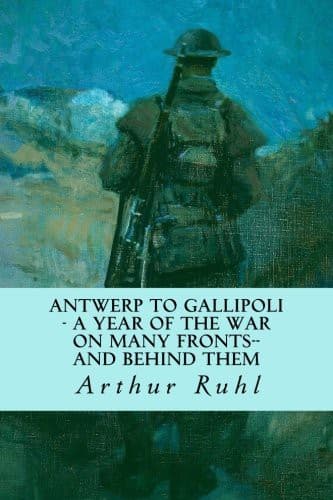
Antwerp to Gallipoli: A Year of the War on Many Fronts—and Behind ThemRuhl, Arthur
History
Antwerp to Gallipoli: A Year of the War on Many Fronts—and Behind Them
Ruhl, Arthur
World War, 1914-1918 -- Personal narratives
From the fields, as we whirled into and out of layers of air, sharply,
as one does in a motor, came now the odor of ripe straw, now a whiff of
coffee from a "goulash cannon," steaming away behind its troop like the
calliope in the old-fashioned circus, and now and then, from some
thicket or across a clover field, the sharp, dismaying smell of rotting
flesh. The countryside lay so tranquil under the August sun that it was
only when one saw a dead animal lying in an open field that one recalled
the fire that, a few days before, must have crisscrossed this whole
country, as now, doubtless, in constant cavalry fights and rear-guard
skirmishes, it was crisscrossing the country up ahead.
Half an hour short of Brest-Litovsk an unfinished bridge turned us off
into a potato field. The soft ground had long since been pounded flat,
as the army, swinging round to the north, had crossed on a pontoon a
mile or two lower down. The motor plunged, snarled, and stopped, and
again, as we shovelled in front and pushed behind, we knew why armies
burn bridges behind them.
Past us, as we sweated there, the slow but surer wagon-trains ploughed
forward. One, a German train, stopped beside us to bait their horses--
officers of the Landwehr or Landsturm type, who looked as if they might
be, as doubtless they were, lawyers, professors, or successful business
men at home. They were from a class who, with us, would generally be
helpless in the field, yet these bronzed, bearded, thoughtful-looking
men seemed just as familiar with the details of their present job as
with the work they had left behind.
Ever since we had crossed into Poland this sober, steel-gray stream had
been mingling with and stiffening our lighter-hearted, more boyish,
blue-gray stream of Austrians and Hungarians. Here were men who knew
what they were doing, believed in it, and had the will to put it
through. One thought of Emerson's "Earnest of the North Wind" whenever
they came in sight.
Those who talk of "frightfulness" and get their notions of German
soldiers from the vaporings of sedentary publicists, who know no more of
them than may be seen through the pipe smoke of their own editorial
rooms, are destined to a melancholy awakening. You may prefer your own
ways, but you cannot make them prevail by blackguarding the other man's
weaknesses; you must beat him where he is strong.
Public-domain text, read in full here on John Shaqi.
Reviews
Reviews
No reviews yet
Be the first to share your thoughts on this work.
Elsewhere in the archive
Join the Discussion
Join the discussion
Sign in to leave a comment or review.
Sign InorCreate an account