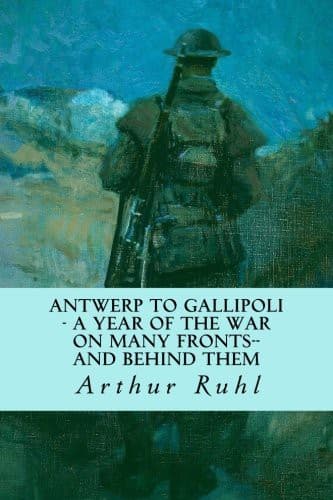
Antwerp to Gallipoli: A Year of the War on Many Fronts—and Behind ThemRuhl, Arthur
History
Antwerp to Gallipoli: A Year of the War on Many Fronts—and Behind Them
Ruhl, Arthur
World War, 1914-1918 -- Personal narratives
Lies and the snobbish ridicule with which our magazines and papers have
been full, run off men like these like water off a duck. These men are
in earnest. They have work to do. No one who has heard them singing the
"Wacht am Rhein" through the starlight of garrisoned towns all the way
from the Channel to the Carpathians, will talk of their being "stolid";
but they have, it is true, no coltishness. They are grown up. And this
discipline of theirs does not mean, as so many people seem to think it
does, being compelled to do what you don't want to do. It means doing
what you are told to do as well as it possibly can be done, no matter
how small it is nor who is looking on--a sense of duty which makes every
switchman behind the lines act as if he were Von Hindenburg. The thing
of theirs, this will-power and moral earnestness, is one of the things
that last--something before which the merely frivolous has always gone
down and always will.
The road down which we were going was, in a general way, the path
already taken by the Austrian and Hungarian troops which had stormed the
outer works at Kobilany two days before and been the first to enter the
town. What happened was much like what had happened at Ivangorod. A
German corps crossed the Bug to north and south and closed in on the
rail-road, the Sixth Austro-Hungarian Corps under Corps General of
Infantry Arz attacked the centre. The Russians sent the entire civil
population eastward, removed their artillery and everything of value
they could take, and set fire to the city. There was a brief artillery
preparation to which the Russians, who all through this retreat appeared
to be short in ammunition and artillery, replied for a time; then the
outer forts were stormed, and when the Sixth Corps entered the burning
city the Russians, except for the rear-guard prisoners, were gone.
We swung past a freight yard littered with over-turned cars, through a
tangle of wagons--army wagons pushing one way and distracted peasants
the other--over a pontoon across the narrow Bug and on into the town.
A city of sixty-five thousand people, with the exception of a church or
two and houses that could almost be counted on one's fingers, was a
waste of gaping windows and blackened chimneys. The Russians' purpose
was not altogether clear, for the town was their town, and its
destruction at this time of the year could not seriously embarrass a
well-provisioned, confident enemy, but they had, at any rate, wiped it
off the map. Not a woman, a child, a glimmer of peaceful life; only
smouldering ruins, the occasional abandoned rifles and cartridge-boxes
of the army that had retired, and the endless wagon-trains of the army
pursuing them.
Public-domain text, read in full here on John Shaqi.
Reviews
Reviews
No reviews yet
Be the first to share your thoughts on this work.
Elsewhere in the archive
Join the Discussion
Join the discussion
Sign in to leave a comment or review.
Sign InorCreate an account