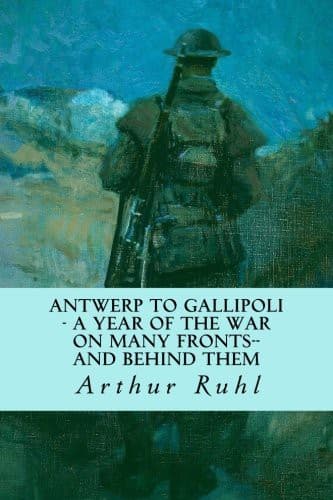
Antwerp to Gallipoli: A Year of the War on Many Fronts—and Behind ThemRuhl, Arthur
History
Antwerp to Gallipoli: A Year of the War on Many Fronts—and Behind Them
Ruhl, Arthur
World War, 1914-1918 -- Personal narratives
All the dust through which we had ridden since morning seemed to have
gathered over that dismal wreck. It was a fog in the streets, on which
darkness was already settling--streets without a lamp or a sound except
that from the onflowing trains. Through this dust we tried to find the
headquarters of the Sixth Army Corps. To its commander our passes took
us and without him we had no reason for being in Brest-Litovsk. Nobody
knew where the Sixth was. Two Hungarian officers, hurrying by in a
commandeered carriage, shouted back something about the "church with a
blue cupola"; somebody else said "near the schnapps factory"; a beaming
young lieutenant, helping to disentangle wagon-trains at the main street
comers, said that the Sixth had marched at three that morning. We had
driven all day with nothing to eat but a bit of war bread and chocolate,
we were black with dust, there was not a crumb in the place that did not
belong to the army, and we sat there in the thickening dusk, almost as
much adrift as a raft in mid-ocean,
The two armies--wagon-trains, that is to say--were crossing each other
at that corner. The Germans were going one way, the Austro-Hungarians
the other--tired, dust-covered horses and men, anonymous cogs in the
vast machine, which had been following the man ahead since the day
before, like enough, and might go on into another day before they could
make camp.
Young Hungarian officers greeted one another gayly, and exchanged the
day's adventures and news; young Germans rode by, slim, serious, and
self-contained. Now the stream would stop as one line tried to break
through the other, puzzled drivers would yank their horses back, then
some determined section commander would come charging back, fling his
horse into the tangle--wagon tongues jammed into the canopy in front,
protestations in German, Hungarian, Polish, Slovak, goodness knows what,
until at last one line gave way and the other shot forward through the
dust again.
I had been in another captured city, with the besieged then, and when I
think of Antwerp it is of the creepy, bright stillness during the
bombardment--the autumn sun, the smell of dead leaves, the shuttered
streets, without a sound except when a shell came screaming in from the
country or, a block or so away, there was a detonation and some facade
came rumbling down. But when I think of Brest-Litovsk it will be of
dust--dust like fog and thickened with the smoke and twilight--and that
strange, wild, creaking stream of wagons fighting through it as they
might have fought in the days when Europe was young and whole races of
men came pouring over the frontiers.
Public-domain text, read in full here on John Shaqi.
Reviews
Reviews
No reviews yet
Be the first to share your thoughts on this work.
Elsewhere in the archive
Join the Discussion
Join the discussion
Sign in to leave a comment or review.
Sign InorCreate an account