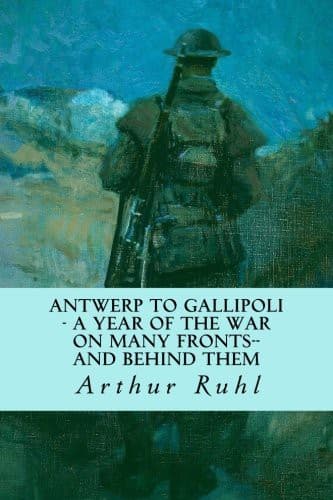
Antwerp to Gallipoli: A Year of the War on Many Fronts—and Behind ThemRuhl, Arthur
History
Antwerp to Gallipoli: A Year of the War on Many Fronts—and Behind Them
Ruhl, Arthur
World War, 1914-1918 -- Personal narratives
You can imagine that gray horde rolling through the streets--narrow,
cobblestoned streets, with steep-roofed stone houses and queer little
courts, and the air over all of having been lived in for generations on
generations. There is the remnant in Crepy of one of the houses that
used to belong to the Dukes of Valois, and at the end of one winding
street you find yourself unexpectedly looking through a grilled iron
gateway into the ordered stateliness of an old-time chateau. On the
outward side the walls of the chateau garden drop a sheer thirty or
forty feet to the edge of the ravine. What a place to wait for an
approaching enemy, one thinks, walking underneath; and the Germans
evidently thought so too, for from this part of town they carefully kept
away. They burned one house, that of a dressmaker so unfortunate as to
live next door to a shop in which arms were sold, they pillaged the
houses whose owners had run away, and they ordered the town to pay them
one hundred thousand francs, but those townspeople who had the fortitude
to stay behind were not molested. The enemy were even polite, one woman
told us--"Pas peur!" said the officer who visited her house, taking off
his hat. On the gate of another house was scrawled in German script,
"Sick Woman--keep away!" and as we passed the open windows, sure enough
there was the pale young mother lying propped up in bed just as she had
been when the Germans came.
On another door we read, also in German script, "Good people--they give
everything!" and on several were orders to leave those within alone. And
there was a curious and touching irony in that phrase: "Gute Leute--
Schoenen!" chalked in stiff script by those now fighting for their lives
to the north of us and likely never to see their fatherland again.
Crepy-en-Valois, more fortunate than some of the towns, whose mayors
were dismissed for revealing "a lamentable absence of sang-froid," had a
mayor who stuck to his post. He was there when three-fourths of the
village had fled and, getting up from a sick-bed to receive the German
commander, he saw that the latter's orders were carried out, and signed
the order for the town's ransom while his daughter held smelling-salts
under his nose.
Whether the mayor of the old town of Senlis, a few miles west of Crepy,
was in any way tactless is scarcely of importance now, in so far as it
concerns him for he and the other hostages were shot, and, however
little good it may have done anybody, he at least gave France his life.
It is said that his order to the townspeople to turn in their arms was
not completely obeyed. It was also said--and this several people of
Senlis told us--that a few Senegalese, lagging behind as the French
left, fired on the Germans as they approached, and that it was possible
that one or two excited civilians had joined in.
Public-domain text, read in full here on John Shaqi.
Reviews
Reviews
No reviews yet
Be the first to share your thoughts on this work.
Join the Discussion
Join the discussion
Sign in to leave a comment or review.
Sign InorCreate an account