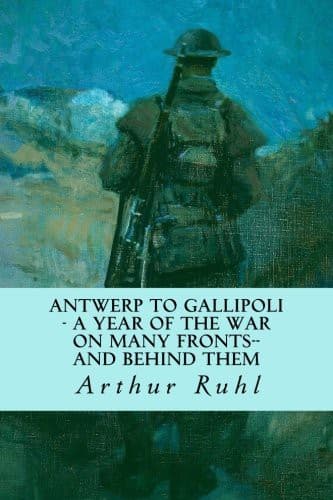
Antwerp to Gallipoli: A Year of the War on Many Fronts—and Behind ThemRuhl, Arthur
History
Antwerp to Gallipoli: A Year of the War on Many Fronts—and Behind Them
Ruhl, Arthur
World War, 1914-1918 -- Personal narratives
"Listen here!" she would say, grabbing my arm. "I want to tell you
something. I'm going to see this thing--d'you know what I mean?--for
what it'll do to me--you know--for its effect on my mind! I didn't say
anything about it to anybody--they'd only laugh at me--d'you know what I
mean? They don't think I've got any serious side to me. Now, I don't
mind things--I mean blood--you know--they don't affect me, and I've read
about nursing--I've prepared for this! Now, I don't know how to go about
it, but it seems to me that a woman who can--you know--go right with
'em--jolly 'em along--might be just what they'd want--d'you know what I
mean?"
One Russian had said good-by to a friend at the dock, he to try to get
through this way, the other by the Pacific and Trans-Siberian. The
Englishman who shared my stateroom was an advertising man. "I've got
contracts worth fifty thousand pounds," he said, "and I don't suppose
they're worth the paper they're written on." There were several Belgians
and a quartet of young Frenchmen who played cards every night and
gravely drank bottle after bottle of champagne to the glory of France.
Even the Balkans were with us, in the shape of a tall, soldier-like
Bulgarian with a heavy mustache and the eyes of a kindly and highly
intelligent hawk. He was going back home--"to fight?" "Yes, to fight."
"With Servia?" asked some one politely, with the usual vague American
notion of the Balkan states. The Bulgarian's eyes shone curiously.
"You have a sense of humor!" he said.
This man had done newspaper work in Russia and America, studied at
Harvard, and he talked about our politics, theatres, universities,
society generally. It was a pity, he said, and the result of the
comparative lack of critical spirit in America that Mr. Roosevelt had
been a hero so long. There were party papers mechanically printing their
praise or blame--"and then, of course, the New York Evening Post and the
Springfield Republican"--but no general intelligent criticism of ideas
for a popular idol to meet and answer. "On the whole, he's a good
influence--but in place of something better. It isn't good for a man to
stand so long in the bright sunshine."
That it was impossible for the Mexicans to work out their own salvation
he doubted. "I think of Bulgaria--surely our inheritance of Turkish
rule was almost as bad, and of how the nation has responded, and of the
intensive culture we had at a time when we were only a name to most
western Europeans." He was but one of those new potentialities which
every whisper from the now cloud-wrapped Continent seemed to be opening
--this tall, scholar-fighter from the comic-opera land where Mr. Shaw
placed his chocolate soldiers.
Public-domain text, read in full here on John Shaqi.
Reviews
Reviews
No reviews yet
Be the first to share your thoughts on this work.
Join the Discussion
Join the discussion
Sign in to leave a comment or review.
Sign InorCreate an account