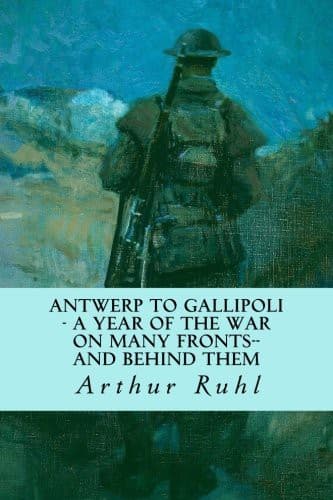
Antwerp to Gallipoli: A Year of the War on Many Fronts—and Behind ThemRuhl, Arthur
History
Antwerp to Gallipoli: A Year of the War on Many Fronts—and Behind Them
Ruhl, Arthur
World War, 1914-1918 -- Personal narratives
All that night it rained, and, through the rain and dark, trains kept
pouring on up into the terrible north. Once I heard cattle lowing as
their cars clanked past, and again, in the gloomy clairvoyance of night,
saw the faces on the field at Betz, beaten on by the rain that had
beaten them for days. And just before a feeble daylight returned again,
the steady rumble of artillery.
After noon there was a break in the clouds, and we started on foot for
Villers-Cotterets, some fifteen kilometres away. The hard macadam road
was no more than dampened, and ambulances and motor-trucks went scooting
by as on a city street. Occasionally there was an abandoned trench,
once a broken caisson, and the wreck of an aeroplane, but the wheat was
harvested and stacked. Beyond Vaumoise the country grew more hilly, and
the caves and quarries, which the Germans were making such effective use
of along the Aisne, began to appear.
And all this time the cannon were thundering--so close that it seemed
each hilltop would bring them into view, and as the detonation puffed
across the landscape, one even fancied one could feel the concussion in
one's ear. Up from a field ahead of us an aeroplane rose and, in a wide
spiral, went climbing up the sky, now almost cleared, and presently
disappeared in the north. Then, after satisfying a sentry that our
papers were correct--such things could be done in those first days--we
got into Villers-Cotterets. Instead of deserted houses we found that
nearly every house was quartering soldiers. There were infantrymen,
dragoons, flyers, Senegalese, Algerians in white turbans and burnooses
on their desert horses, and everywhere officers. We had stumbled into a
headquarters!
With somewhat the sensation of walking a tight rope, we sought the mayor
to ask for permission to stay in town--finally to ask for safe-conducts
to Soissons. The charming old gentleman, undisturbed by war's alarms,
politely made them out.
Presently in a hotel full of officers we came on three civilians calmly
eating dinner. They had arrived by train, although there were no trains
for civilians; they were now dining at a long table set for officers
from which we had a moment before been turned away; and we were rescued
by a mysterious being at the head of the table--a dark, bald,
bright-eyed, smiling, sanguine gentleman, who might have been an
impresario or a press agent, and continually had the air of saying, as
from time to time he actually said: "Ssst! Leave it all to me!"
Public-domain text, read in full here on John Shaqi.
Reviews
Reviews
No reviews yet
Be the first to share your thoughts on this work.
Join the Discussion
Join the discussion
Sign in to leave a comment or review.
Sign InorCreate an account