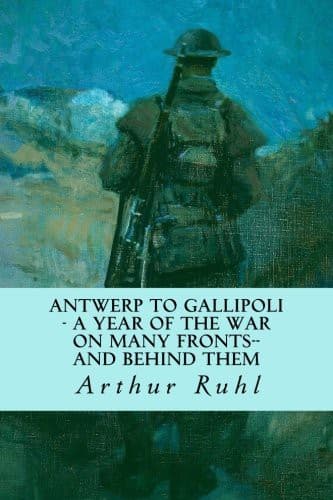
Antwerp to Gallipoli: A Year of the War on Many Fronts—and Behind Them — John Shaqi
Antwerp to Gallipoli: A Year of the War on Many Fronts—and Behind ThemRuhl, Arthur
History
Antwerp to Gallipoli: A Year of the War on Many Fronts—and Behind Them
Ruhl, Arthur
World War, 1914-1918 -- Personal narratives
"Take almost any of those little French soldiers--they've got a pretty
good idea what the war is about--at any rate, they've got a sentiment
about it perfectly clear and conscious, and they'll go to their death
shouting for la patrie. Now, Tommy Atkins isn't the least like that.
He doesn't fight--and you know how he does fight--for patriotism or
glory, at least not in the same conscious way. He'd fight just as well
against another of his own regiments--if you know what I mean. He's
just--well, look at the soldiers' letters. The Germans are sentimental
--they are all martyrs. The Frenchmen are all heroes. But Tommy Atkins
--well, he's just playing football!"
The idea this Englishman was trying to express was put in another way by
a British sailor at the time of the sinking of the Aboukir, Cressy, and
Rogue.
Imagine, for a moment, that scene--the three great ships going over like
stricken whales, men slipping down their slimy flanks into the sea,
boats overturned and smashed, in the thick of it the wet nose of the
German submarine coming up for a look round, and then, out of that
hideous welter, the voice of a sailor, the unalterable Briton in the
face of all this modern science and sea magic, grabbing an anchor or
whatever it was he saw first, and bellowing:
"Smash the blighter's head!"
There are phrases like these which could only have been said by the
people who say them; they are like windows suddenly opening down cycles
of racial history and difference. At a Regent Street moving-picture
show a few evenings ago two young Frenchwomen sat behind us, girls
driven off the Paris boulevards by the same impartial force which has
driven grubbing peasant women from the Belgian beet-fields. One spoke a
little English, and as the pictures changed she translated for her
companion.
There were pictures of the silk industry in Japan--moths emerging from
cocoons, the breeding process, the hatching of the eggs, the life
history of these anonymous little specks magnified until for the moment
they almost had a sort of personality. And one murmured:
"Comme c'est drole, la nature!"
Sunday.
It was dusk when we reached Boulogne last night--frosty dusk, with the
distant moan of a fog-horn, and under the mist hilly streets busy with
soldiers and bright with lights. It made one think of a college town at
home on the eve of the great game, so keen and happy seemed all these
fit young men--officers swinging by with their walking-sticks, soldiers
spinning yarns in smoky cafes--for the great game of war.
Public-domain text, read in full here on John Shaqi.
Reviews
Reviews
No reviews yet
Be the first to share your thoughts on this work.
Join the Discussion
Join the discussion
Sign in to leave a comment or review.
Sign InorCreate an account