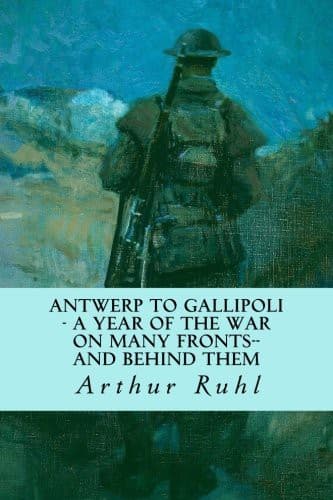
Antwerp to Gallipoli: A Year of the War on Many Fronts—and Behind ThemRuhl, Arthur
History
Antwerp to Gallipoli: A Year of the War on Many Fronts—and Behind Them
Ruhl, Arthur
World War, 1914-1918 -- Personal narratives
There were no music-halls in Belgium and there were posters on the blank
walla, even of little villages, reminding bands and hurdy-gurdy players
and the proprietors of dance-halls that this was no time for unnecessary
noise. There were no soldiers going gayly off to war; the Belgians were
coming back from war. They had been asked to hold out for three days,
and they had held for three weeks. All their little country was a
battle-field, and Belgium open to the invader.
It was too late to get to Brussels, but there was still a train to
Antwerp. At Puers soldiers were digging trenches and stringing
approaches with barbed wire. The dikes had been opened and part of the
country flooded. Farther on we passed the Antwerp forts, then comely
suburbs where houses had been torn down and acres of trees and shrubs--
precious, as may be imagined, to a people who line their country roads
with elms and lindens like avenues in parks, and build monuments to
benevolent-looking old horticulturists--chopped down and burned. And
go, presently, into the old city itself, dull-flaming with the scarlet,
gold, and black, of the Belgian flag, and with something that seemed to
radiate from the life itself of this hearty, happy people, after all
their centuries of trade and war, and good food, and good art--like
their own Rubenses and Van Dycks.
There was no business, not a ship moving in the Scheldt. All who worked
at all were helping prepare for the possible siege; those who didn't
crowded the sidewalk cafes, listening to tales from the front, guessing
by the aid of maps whither, across the silent, screened southwest, the
German avalanche was spreading.
"Treason," "betrayal," "savagery," were on everybody's lips. For
Antwerp, you might say, had been "half German"; many of its rich and
influential men were of German origin, although they had lived in
Belgium for years. And now the Belgians felt they had lived there as
spies, and the seizure of Belgium was an act long and carefully planned.
One was told of the finding of rifles in German cellars, marked
"Preserves," of German consuls authorized to give prizes for the most
complete inventories of their neighborhoods turned in by amateur spies.
Speaking to one man about the Rubens "Descent from the Cross" still
hanging in the cathedral, I suggested that such a place was safe from
bombardment. He looked up at the lace-like old tower, whose chimes,
jangling down through leaping shafts and jets of Gothic stone, have so
long been Antwerp's voice. "They wouldn't stop a minute," he said.
Public-domain text, read in full here on John Shaqi.
Reviews
Reviews
No reviews yet
Be the first to share your thoughts on this work.
Join the Discussion
Join the discussion
Sign in to leave a comment or review.
Sign InorCreate an account