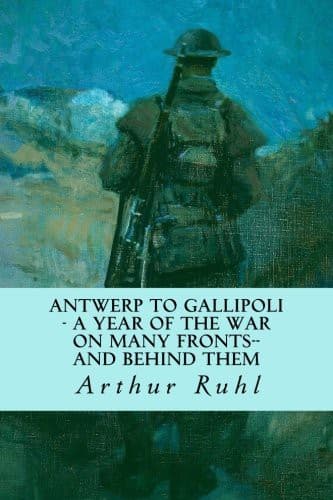
Antwerp to Gallipoli: A Year of the War on Many Fronts—and Behind ThemRuhl, Arthur
History
Antwerp to Gallipoli: A Year of the War on Many Fronts—and Behind Them
Ruhl, Arthur
World War, 1914-1918 -- Personal narratives
"Society," in its more visible, decorative sense, is as forgotten as it
is in France, as it must be in such a time. There are no dances or
formal parties; every one who is not going about his civil business has
in one way or another "gone to the war." The gay young men are at the
front, the idle young women knitting or nursing or helping the poor, and
it is an adventure uncommon enough to be remembered to meet on the
street a pretty young lady merely out to take the air, with hands in her
muff and trotting in front of her the timorous dachshund, muzzled like a
ravening tiger and looking at the world askance with his rueful eyes.
The apparent quietness and gravity is partially due to the lack of a
"yellow" or, in the British or American sense of the word, popular
press. There is none of that noisy hate continually dinned into one's
ears in London by papers which, to be sure, represent neither the
better-class English civilians nor the light-hearted fighting man at the
front, yet which are entertainingly written, do contain the news, and
get themselves read.
The German papers print comparatively little of what we call "news."
They hide unpleasant truths and accent pleasant ones, and are working
all the time to create a definite public opinion; but their partisanship
is that of official proclamation rather than that of overworked and
underpaid reporters striving to please their employers with all the
desperation of servants working for a tip. The yelping after spies, the
heaping of adjectives on every trifling achievement of British arms, the
ill-timed talk of snatching the enemy's trade in a war theoretically
fought for a high principle, all that journalistic vulgarity--which
might be as characteristic of our own papers under similar
circumstances--one is mercifully spared.
This taciturnity is astonishing toward the work of the men at the front.
A few days ago flags were flung out all over Berlin at the news of
Hindenburg's victory; military attaches were saying that there had been
nothing like this since Napoleon; up and down the streets the newswomen
were croaking: "Sechsund-zwanzig tausend Russen gefangen... Hindenburg
zahlt noch immer..." ("Twenty-six thousand Russians captured... and
Hindenburg's still counting..."). And all you could find in the papers
was the General Staff report that "at one place the fighting has been
very severe; up to the present we have made some twenty-six thousand
prisoners," etc., and even this laconic sentence lost in the middle of
the regular communiqué beginning: "Yesterday on the Belgian coast, after
a period of inactivity..."
Public-domain text, read in full here on John Shaqi.
Reviews
Reviews
No reviews yet
Be the first to share your thoughts on this work.
Elsewhere in the archive
Join the Discussion
Join the discussion
Sign in to leave a comment or review.
Sign InorCreate an account