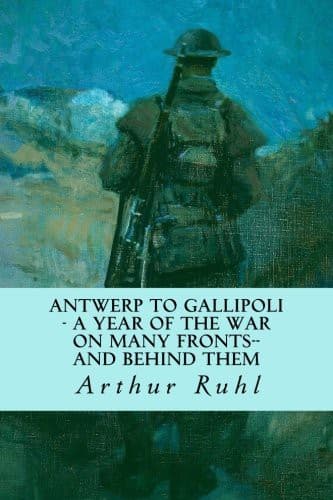
Antwerp to Gallipoli: A Year of the War on Many Fronts—and Behind ThemRuhl, Arthur
History
Antwerp to Gallipoli: A Year of the War on Many Fronts—and Behind Them
Ruhl, Arthur
World War, 1914-1918 -- Personal narratives
The picturesqueness and personalities of the war are left to the stage
and the innumerable weeklies and humorous papers, yet even here there is
little or no tendency to group achievements around individual
commanders--it is "our army," not the man, although even German
collectivism cannot keep Hindenburg's dependable old face off the
post-cards nor regiments of young ladies from sending him letters and
Liebesgaben.
In the theatre you see the Feldgrau heroes in dugouts in Flanders or in
Galician trenches; see the audience weep when the German mother sends
off her seven sons or the bearded father meets his youngest boy, schwer
verwundet, on the battle-field; or cheer when the curtain goes down on
noble blond giants in spiked helmets dangling miniature Frenchmen by the
scruff of the neck and forcing craven Highlanders to bite the dust.
You may even see a submarine dive down into green water, see the torpedo
slid into the tube, breech-block closed, and--"Now--for Kaiser and
fatherland!"--by means of an image thrown on a screen from the
periscope, see the English cruiser go up in a tower of water and
founder.
In all this comment there is a very different feeling for each of the
three allies. The Russians "don't count," so to speak. They are
dangerous because of their numbers and must be flung back, but the
feeling toward them is not unlike that toward a herd of stampeded range
cattle.
Toward the French there is no bitterness either, rather a sort of pity
and the wish to be thought well of. One is reminded now and then of the
German captain quartered at Sedan, in Zola's "Debacle," who, while
conscious of the strength behind him, yet wanted his involuntary hosts
to know that he, too, had been to Paris and knew how to be a galant
homme. Men tell you "they've put up a mighty good fight, say!" or
speaking of the young French sculptor allowed to go on with his work in
the prison camp at Zossen, or the flower-beds in front of the French
barracks there--"but, of course, the French are an artistic people. You
can allow them liberties like that." Every now and then in the papers
one runs across some anecdote from France in which the Frenchman is
permitted to make the retort at the expense of the English.
Toward John Bull there is no mercy. He is shown naked, trying to hide
himself with neutral flags; he is sprawled in his mill with a river of
French blood flowing by from the battle-fields of France, while the
cartoonist asks France if she cannot see that she is doing his grinding
for him; he is hobnobbing cheek by jowl with cannibals and black men,
and he is seriously discussed as a traitor to the Germanic peoples and
the white race.
Public-domain text, read in full here on John Shaqi.
Reviews
Reviews
No reviews yet
Be the first to share your thoughts on this work.
Elsewhere in the archive
Join the Discussion
Join the discussion
Sign in to leave a comment or review.
Sign InorCreate an account