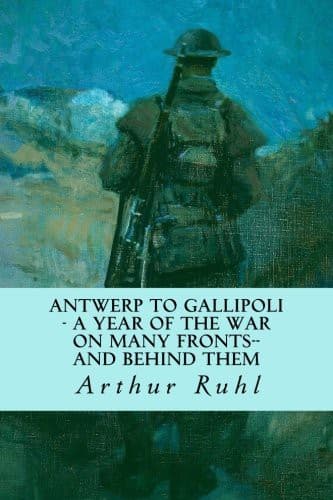
Antwerp to Gallipoli: A Year of the War on Many Fronts—and Behind Them — John Shaqi
Antwerp to Gallipoli: A Year of the War on Many Fronts—and Behind ThemRuhl, Arthur
History
Antwerp to Gallipoli: A Year of the War on Many Fronts—and Behind Them
Ruhl, Arthur
World War, 1914-1918 -- Personal narratives
Yes, I say I shall take them under my protection because my heart bleeds
to think that they, too, have left behind those dear to them--an aged
father, an old mother, a wife, children, sisters, or sweethearts whom
separation has plunged into deepest anguish. Do not forget when you see
these prisoners passing by, I beg of you, and permit yourself to shout
at and insult them. Keep, on the contrary, the respectful silence
appropriate to thinking men. Fellow citizens, if, in these grave and
painful circumstances, you will listen to my advice, if you will recall
that it is now thirty years that I have been your burgomaster and during
all that time of hard work I have never asked a favor of you, I feel
sure that you will obey my request and, on your side, you may be sure
that my gratitude will not be wanting.
A. REYNAEKT, Burgomaster.
Although war had not touched Courtrai as yet, the rumor of it, more
terrifying often than the thing itself, had swept through all Flanders.
Along the level highways leading into Courtrai trooped whole families
carrying babies and what few household things they could fling together
in blankets. Covered wagons overflowed with men, women, and children.
The speed with which rumor spread was incredible. In one village a
group of half-drunken men, who insisted on jeering the Germans were put
at the head of a column and compelled to march several miles before they
were released. The word at once ran the length of dozens of highroads
that the Germans "were taking with them every one between fifteen and
fifty." I heard the same warning repeated on several of the roads about
Courtrai by men and women, panting, red-faced, stumbling blindly on from
they knew not what. Later, I met the same people, straggling back to
their villages, good-naturedly accepting the jibes of those who had
stayed behind.
A linen manufacturer who lived in the village of Deerlyck, not far from
Courtrai, where German scouts had been reported, kindly asked me to come
out and spend the night. For several miles we drove through the densely
populated countryside, past rows of houses whose occupants all seemed to
know him.
Women ran out to stop him and rattled away in Flemish; there were
excited knots of people every few steps, and the heads kept turning this
way and that, as if we were all likely to be shot any minute. We drove
into the courtyard of the solid old Flemish house--a house in which he
and his father before him had lived, with tiny rooms full of old
paintings, garden, stable, and hothouse packed close in the saving
Belgian fashion, and all as spick and span and shining as if built
yesterday--and then into the street again. It was interesting to watch
this square little man roll sturdily along, throwing out his stout arms
impatiently and flinging at the nervous villagers--who treated him
almost as a sort of feudal lord--guttural Flemish commands to keep cool
and not make fools of themselves.
Public-domain text, read in full here on John Shaqi.
Reviews
Reviews
No reviews yet
Be the first to share your thoughts on this work.
Join the Discussion
Join the discussion
Sign in to leave a comment or review.
Sign InorCreate an account