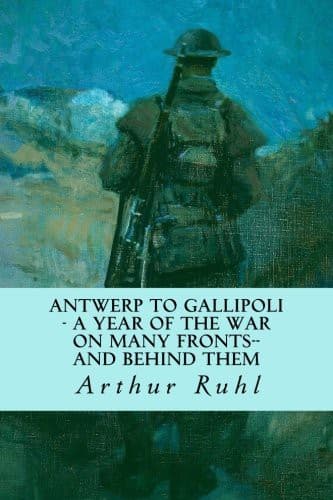
Antwerp to Gallipoli: A Year of the War on Many Fronts—and Behind ThemRuhl, Arthur
History
Antwerp to Gallipoli: A Year of the War on Many Fronts—and Behind Them
Ruhl, Arthur
World War, 1914-1918 -- Personal narratives
And the Germans--how were they? They had no complaints to make, the girl
said; the Germans were well behaved--"tres correct." Possibly, then--it
was our young Italian who put the question--the Belgians would just as
soon... I did not catch the whole sentence, but all at once something
flashed behind that non-committal cafe proprietress's mask. "Moi, je
suis fiere d'etre Belge!" said the girl, and as she spoke you could see
the color slowly burning through her pale face and neck--she was proud
to be a Belgian--they hoped, that one could keep, and there would come a
day, we could be sure of that--"un jour de revanche!"
But business is business, and people who run cafes must, as every one
knows, not long indulge in the luxury of personal feelings. The
officers turned up their fur collars, and we buttoned up our coats, and
she was sitting behind the counter, the usual little woman in black at
the cafe desk, as we filed out. Our captain paused as we passed, gave a
stiff little bow from the waist, touched his cap gallantly, and said:
"Bon jour, mademoiselle!" And the girl nodded politely, as café
proprietresses should, and murmured, blank as the walls in the Antwerp
streets: "Bon jour, monsieur!"
Chapter IX
The Road To Constantinople
Rumania and Bulgaria
The express left Budapest in the evening, all night and all next day
rolled eastward across the Hungarian plain, and toward dusk climbed up
through the cool Carpathian pines and over the pass into Rumania.
Vienna and the waltzes they still were playing there, Berlin and its
iron exaltation, slow-rumbling London--all the West and the war as we
had thought of it for months was, so to speak, on the other side of the
earth. We were on the edge of the East now, rolling down into the
Balkans, into that tangle of races and revenges out of which the first
spark of the war was flung.
Since coffee that morning the lonely train had offered nothing more
nourishing than the endless Hungarian wheat-fields, with their rows of
peasants, men and women, working comfortably together, and rows of
ploughs creeping with almost incredible leisure behind black
water-buffalo cattle; but as we rolled down into Predeal through the
rain, there, at last, in the dim station lamps, glittered the brass
letters and brown paint of the Compagnie Internationale des Wagons
Lits--and something to eat.
Public-domain text, read in full here on John Shaqi.
Reviews
Reviews
No reviews yet
Be the first to share your thoughts on this work.
Elsewhere in the archive
Join the Discussion
Join the discussion
Sign in to leave a comment or review.
Sign InorCreate an account