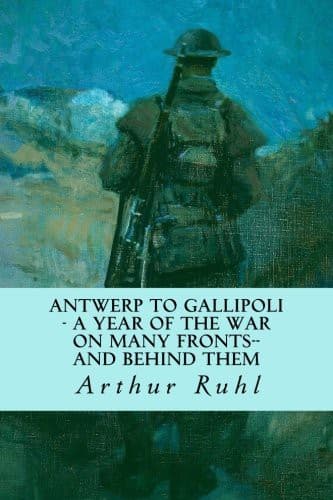
Antwerp to Gallipoli: A Year of the War on Many Fronts—and Behind ThemRuhl, Arthur
History
Antwerp to Gallipoli: A Year of the War on Many Fronts—and Behind Them
Ruhl, Arthur
World War, 1914-1918 -- Personal narratives
The cars of this beneficent institution--survivors of a Europe that once
seemed divided between tourists and hotel-keepers--outdash the most
dashing war correspondents, insinuate themselves wherever civilians are
found at all, and once aboard you carry your oasis with you as you do in
a Pullman through our own alkali and sage-brush. The steward (his
culture is intensive, though it may not extend beyond the telegraph-
poles, and includes the words for food in every dialect between Ostend
and the Golden Horn) had just brought soup and a bottle of thin
Hungarian claret, when the other three chairs at my table were taken by
a Rumanian family returning from a holiday in Budapest--an urbane
gentleman of middle age, a shy little daughter, and a dark-eyed wife,
glittering with diamonds, who looked a little like Nazimova.
"Monsieur is a stranger?" said the Rumanian presently, speaking in
French as Rumanians are likely to do, and we began to talk war. I
asked--a question the papers had been asking for weeks--if Rumania would
be drawn into it.
"Within ten days we shall be in," he said.
"And on which side?"
"Oh!" he smiled, "against Austria, of course!"
That was in April. When I came through Rumania three months later
soldiers were training everywhere in the hot fields; Bucarest was full
of officers, the papers and cafes still buzzing with war talk. Rumania
was still going in, but since the recapture of Lemberg and the Russian
retreat the time was not so sure--not, it seemed, "until after the
harvest" at any rate.
I asked the Rumanian what he thought about Italy. "Italy began as a
coquette. She will end"--he made the gesture of counting money into his
hand--"she will end as a cocotte." He waved a forefinger in front of his
face.
"Elle n'est plus vierge!" he said.
The wife demurred. Italy was poor and little, she must needs coquette.
After all, il faut vivre--one must live.
Something was said of America and the feeling there, and the wife
announced that she would like of all things to see America, but--she did
not wish to go there with her husband. I suggested that she come with
me--an endeavor to rise to the Rumanian mood which was received with
tolerant urbanity by her husband, and by the lady who looked like
Nazimova with very cheering expressions of assent.
"When you return from Constantinople," she flashed back as they left the
table, "don't forget!"
These were the first Rumanians I had met. They were amiable, they spoke
French--it almost seemed as if they had heard the tales that are usually
told of their little capital, and were trying to play the appropriate
introduction to Bucarest.
Public-domain text, read in full here on John Shaqi.
Reviews
Reviews
No reviews yet
Be the first to share your thoughts on this work.
Elsewhere in the archive
Join the Discussion
Join the discussion
Sign in to leave a comment or review.
Sign InorCreate an account