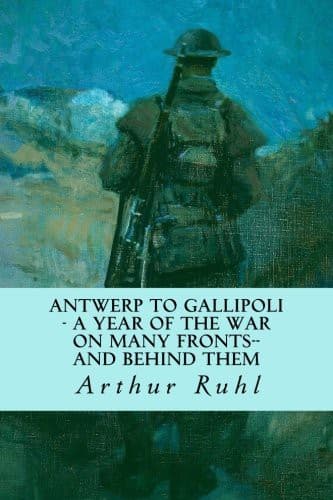
Antwerp to Gallipoli: A Year of the War on Many Fronts—and Behind ThemRuhl, Arthur
History
Antwerp to Gallipoli: A Year of the War on Many Fronts—and Behind Them
Ruhl, Arthur
World War, 1914-1918 -- Personal narratives
Here it is, this little nation, only a trifle larger than the State of
Pennsylvania, a half-Latin island in an ocean of Magyars and Slavs. On
the north is Russia, on the south the grave and stubborn Bulgars (Slav
at any rate in speech), on the west Hungary, and here, between the
Carpathians and the Black Sea, this Frenchified remnant of the empire of
ancient Rome. Their speech when it is not French is full of Latin
echoes, and a Rumanian, however mixed his blood, is as fond of thinking
himself a lineal and literal descendant of the Roman colonists as a New
Englander is of ancestors in the Mayflower. At the Alhambra in Bucarest
next evening, after the cosmopolite artistes had done then-perfunctory
turns and returned to their street clothes and the audience, to begin
the more serious business of the evening, the movie man in the gallery
threw on the screen--no, not some military hero nor the beautiful Queen
whose photograph you will remember, but the head of the Roman Emperor
Trajan! And the listless crowd, drowsing cynically in its tobacco smoke,
broke into obedient applause, just as they would at home at the sight of
the flag or a picture of the President.
Bucarest, like all the capitals of Spanish America, is another "little
Paris," but the Rumanians, possibly because unhampered by sombre Spanish
tradition or perhaps any traditions at all, succeed more completely in
borrowing the vices and escaping the virtues of the great capital they
are supposed to imitate. It would be more to the point to call Bucarest
a little Buenos Aires. There is much the same showiness; a similar
curious mixture of crudeness and luxury. But Buenos Aires is one of the
world's great cities, and always just beyond the asphalt you can somehow
feel the pampa and its endless cattle and wheat. The Rumanian capital
is a town of some three hundred thousand people in a country you could
lose in the Argentine, and there is nothing, comparatively speaking, to
offset its light-mindedness, to suggest realities behind all this life
of patisserie.
You should see the Calea Vittorei on one of these warm summer evenings
between five and eight. It is a narrow strip of asphalt winding through
the centre of the town, with a tree-shaded drive at one end, and the
hotels, sidewalk cafes, and fashionable shops at the other, and up and
down this narrow street, in motors, in open victorias driven by Russian
coachmen in dark-blue velvet gowns reaching to their heels, all Bucarest
crowds to gossip, flirt, and see.
Public-domain text, read in full here on John Shaqi.
Reviews
Reviews
No reviews yet
Be the first to share your thoughts on this work.
Elsewhere in the archive
Join the Discussion
Join the discussion
Sign in to leave a comment or review.
Sign InorCreate an account