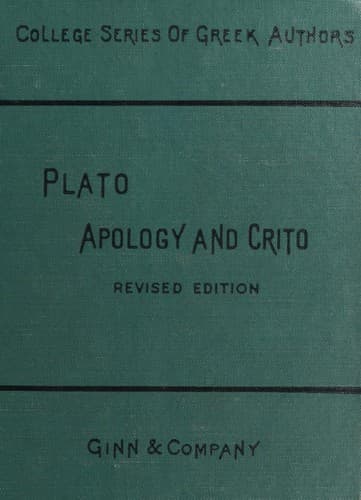
Classical literature; Philosophy, Ancient; Socrates, 470 BC-399 BC
Then, by the gods, Meletus, of whom we are speaking, tell me and the
court, in somewhat plainer terms, what you mean! for I do not as yet
understand whether you affirm that I teach other men to acknowledge
some gods, and therefore that I do believe in gods, and am not an
entire atheist—this you do not lay to my charge,—but only you say that
they are not the same gods which the city recognizes—the charge is that
they are different gods. Or, do you mean that I am an atheist simply,
and a teacher of atheism?
I mean the latter—that you are a complete atheist.
What an extraordinary statement! Why do you think so, Meletus? Do you
mean that I do not believe in the godhead of the sun or moon, like
other men?
I assure you, judges, that he does not: for he says that the sun is
stone, and the moon earth.
Friend Meletus, you think that you are accusing Anaxagoras: and you
have but a bad opinion of the judges, if you fancy them illiterate to
such a degree as not to know that these doctrines are found in the
books of Anaxagoras the Clazomenian, which are full of them. And so,
forsooth, the youth are said to be taught them by Socrates, when there
are not unfrequently exhibitions of them at the theatre (Probably in
allusion to Aristophanes who caricatured, and to Euripides who borrowed
the notions of Anaxagoras, as well as to other dramatic poets.) (price
of admission one drachma at the most); and they might pay their money,
and laugh at Socrates if he pretends to father these extraordinary
views. And so, Meletus, you really think that I do not believe in any
god?
I swear by Zeus that you believe absolutely in none at all.
Nobody will believe you, Meletus, and I am pretty sure that you do not
believe yourself. I cannot help thinking, men of Athens, that Meletus
is reckless and impudent, and that he has written this indictment in a
spirit of mere wantonness and youthful bravado. Has he not compounded a
riddle, thinking to try me? He said to himself:—I shall see whether the
wise Socrates will discover my facetious contradiction, or whether I
shall be able to deceive him and the rest of them. For he certainly
does appear to me to contradict himself in the indictment as much as if
he said that Socrates is guilty of not believing in the gods, and yet
of believing in them—but this is not like a person who is in earnest.
I should like you, O men of Athens, to join me in examining what I
conceive to be his inconsistency; and do you, Meletus, answer. And I
must remind the audience of my request that they would not make a
disturbance if I speak in my accustomed manner:
Public-domain text, read in full here on John Shaqi.
Reviews
Reviews
No reviews yet
Be the first to share your thoughts on this work.
Join the Discussion
Join the discussion
Sign in to leave a comment or review.
Sign InorCreate an account