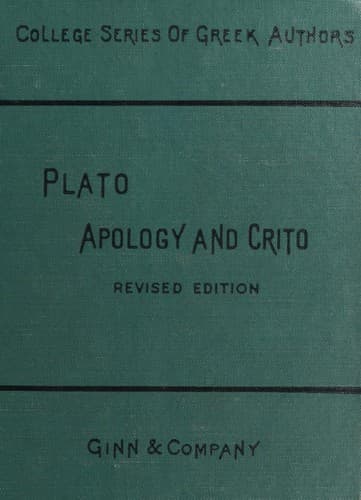
Classical literature; Philosophy, Ancient; Socrates, 470 BC-399 BC
Some one will say: Yes, Socrates, but cannot you hold your tongue, and
then you may go into a foreign city, and no one will interfere with
you? Now I have great difficulty in making you understand my answer to
this. For if I tell you that to do as you say would be a disobedience
to the God, and therefore that I cannot hold my tongue, you will not
believe that I am serious; and if I say again that daily to discourse
about virtue, and of those other things about which you hear me
examining myself and others, is the greatest good of man, and that the
unexamined life is not worth living, you are still less likely to
believe me. Yet I say what is true, although a thing of which it is
hard for me to persuade you. Also, I have never been accustomed to
think that I deserve to suffer any harm. Had I money I might have
estimated the offence at what I was able to pay, and not have been much
the worse. But I have none, and therefore I must ask you to proportion
the fine to my means. Well, perhaps I could afford a mina, and
therefore I propose that penalty: Plato, Crito, Critobulus, and
Apollodorus, my friends here, bid me say thirty minæ, and they will be
the sureties. Let thirty minæ be the penalty; for which sum they will
be ample security to you.
Not much time will be gained, O Athenians, in return for the evil name
which you will get from the detractors of the city, who will say that
you killed Socrates, a wise man; for they will call me wise, even
although I am not wise, when they want to reproach you. If you had
waited a little while, your desire would have been fulfilled in the
course of nature. For I am far advanced in years, as you may perceive,
and not far from death. I am speaking now not to all of you, but only
to those who have condemned me to death. And I have another thing to
say to them: you think that I was convicted because I had no words of
the sort which would have procured my acquittal—I mean, if I had
thought fit to leave nothing undone or unsaid. Not so; the deficiency
which led to my conviction was not of words—certainly not. But I had
not the boldness or impudence or inclination to address you as you
would have liked me to do, weeping and wailing and lamenting, and
saying and doing many things which you have been accustomed to hear
from others, and which, as I maintain, are unworthy of me. I thought at
the time that I ought not to do anything common or mean when in danger:
nor do I now repent of the style of my defence; I would rather die
having spoken after my manner, than speak in your manner and live. For
neither in war nor yet at law ought I or any man to use every way of
escaping death. Often in battle there can be no doubt that if a man
will throw away his arms, and fall on his knees before his pursuers, he
may escape death; and in other dangers there are other ways of escaping
death, if a man is willing to say and do anything. The difficulty, my
friends, is not to avoid death, but to avoid unrighteousness; for that
Public-domain text, read in full here on John Shaqi.
Reviews
Reviews
No reviews yet
Be the first to share your thoughts on this work.
Join the Discussion
Join the discussion
Sign in to leave a comment or review.
Sign InorCreate an account