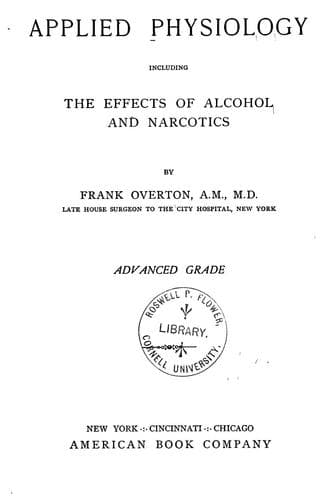
Applied Physiology, Including the Effects of Alcohol and NarcoticsOverton, Frank
Science
Applied Physiology, Including the Effects of Alcohol and Narcotics
Overton, Frank
Physiology
Making strong drink takes thousands of men away from good work. They
might work at building houses, or raising grain, or teaching school.
As it is, their work is wasted.
A great deal of money is wasted on strong drink. All the mines of the
world cannot produce enough gold and silver to pay the drink bill. The
people of the United States pay more for strong drink than for bread.
The price of two or three drinks a day would amount to enough, in ten
years, to buy a small home.
The cost of strong drink is made much greater if we count the cost of
jails and insane asylums. Over one half of all crimes and cases of
insanity are caused by strong drink.
We must also add the misery and suffering of most children of drunken
fathers. This loss cannot be counted in money. Numbers of children
become truants from school and learn theft and falsehoods from lack of
a father's care. When all the cost is counted, nothing will be found
so expensive as strong drink.
On the other hand, what do people get for their money and suffering?
They get only a little pleasure, and then they are ashamed of it. Men
use strong drink only because they like it more than they dislike its
bad effects.
Since drink does a great deal of harm, with no good to any one, it is
right to make laws to control its sale.
=161. How tobacco affects the brain.=--Some men smoke to make
themselves think, and some to keep themselves from thinking. Now,
smoking cannot do both things. It really makes the brain less able to
think, for it weakens the whole body. A school-boy's brain will surely
be harmed if he uses tobacco at all.
WHAT WE HAVE LEARNED
1. The mind makes all the cells of the body work together.
2. Tiny nerve threads carry messages from the mind to the cells.
3. Most of the nerves begin at the spinal cord in the backbone.
4. The mind in the spinal cord tells the cells to eat and grow.
It tells the arteries how much blood to carry to the cells.
5. The cells tell the spinal cord if they need food, or if
something suddenly hurts them. The spinal cord sends word to
snatch the part from danger.
6. Nerves carry to the brain news of sight, sound, odor, taste,
and touch.
7. The brain sends word to the muscles to move the arms, the
legs, and the rest of the body.
8. The brain thinks.
9. The brain stores up all its messages; these make memory and
knowledge.
10. The thought part of the brain can control the feelings and
the movements of the body.
11. Alcohol is more harmful to the brain than to any other part
of the body.
CHAPTER XIII
THE SENSES
=162.= A man has five ways of knowing about things outside of the
body. He can feel, see, hear, smell, and taste.
=163. Feeling.=--Nerves go to nearly every cell in the body. They
carry news to the brain when anything touches them. The news produces
a feeling. Feelings are of three kinds:--
Public-domain text, read in full here on John Shaqi.
Reviews
Reviews
No reviews yet
Be the first to share your thoughts on this work.
Join the Discussion
Join the discussion
Sign in to leave a comment or review.
Sign InorCreate an account