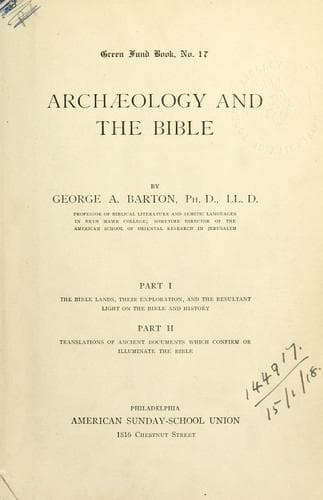
Archæology and the BibleBarton, George A. (George Aaron)
Religion
Archæology and the Bible
Barton, George A. (George Aaron)
Bible -- Antiquities; Egypt -- Antiquities; Middle East -- Antiquities
In this account only the principal explorations have been mentioned. In
all parts of Palestine, and especially at Jerusalem, important
archæological discoveries are frequently made when people are digging to
lay the foundations of buildings, to construct a cistern, or for other
purposes. Other important discoveries, as, for instance, the rock-cut high
place at Petra,[68] and the painted tombs at Beit Jibrin,[69] have been
made by people traveling through the land. Many discoveries made in this
way are recorded in the Quarterly Statement of the Palestine Exploration
Fund, the _Zeitschrift des deutschen Palästina-Vereins_, and the _Revue
biblique_. Lack of space forbids the attempt to chronicle these.[70]
CHAPTER V
OUTLINE OF PALESTINE’S ARCHÆOLOGICAL HISTORY
THE EARLY STONE AGE. THE LATE STONE AGE. THE AMORITES. THE CANAANITES.
EGYPTIAN DOMINATION: Thothmes III. Palestine in the El-Amarna Letters.
Seti I. Ramses II. Merneptah. Ramses III. THE PHILISTINES. THE
HEBREWS. PHILISTINE CIVILIZATION. THE HEBREW KINGDOMS. THE EXILE AND
AFTER: The Samaritans. Alexander the Great and his successors. The
Maccabees. The Asmonæans. THE COMING OF ROME: The Herods. The
destruction of Jerusalem in 70 A. D. LATER HISTORY.
=1. The Early Stone Age.=--Palestine appears to have been inhabited at a
very remote period. Scholars divide the races of prehistoric men, who used
stone implements, into two classes--Palæolithic and Neolithic. Palæolithic
men did not shape their stone implements. If they chanced to find a stone
shaped like an axe, they used it as such; if they found a long, thin one
with a sharp edge, they used it for a knife. Neolithic man had learned to
shape his stone tools. He could make knives for himself out of flint and
form other tools from stone. The earliest inhabitants of Palestine
belonged to the palæolithic period. Unshaped stone implements have been
found in many parts of the country. They have been picked up in the
maritime plain, in still larger numbers on the elevated land south of
Jerusalem, and again to the south of Amman, the Biblical Rabbah Ammon, on
the east of the Jordan. The Assumptionist Fathers of Notre Dame de France
at Jerusalem have a fine collection of flint implements in their Museum.
These palæolithic men lived in caves in which they left traces of their
occupation. Several of these caves in Phœnicia have been explored by Père
Zumoffen, of the Catholic University of St. Joseph, Beirut.[71] It has
been estimated that these cave-dwellers may have been in Palestine as
early as 10,000 B. C.
Public-domain text, read in full here on John Shaqi.
Reviews
Reviews
No reviews yet
Be the first to share your thoughts on this work.
Elsewhere in the archive
Join the Discussion
Join the discussion
Sign in to leave a comment or review.
Sign InorCreate an account