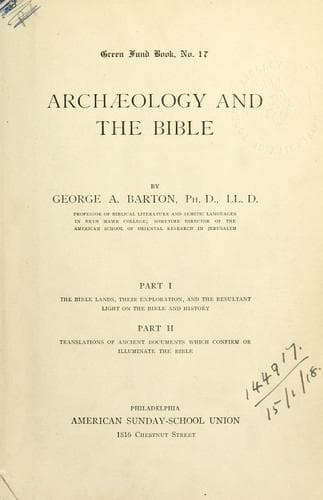
Archæology and the BibleBarton, George A. (George Aaron)
Religion
Archæology and the Bible
Barton, George A. (George Aaron)
Bible -- Antiquities; Egypt -- Antiquities; Middle East -- Antiquities
=8. Parker’s Excavations at Jerusalem.=--In the years 1909, 1910, and 1911
an English expedition under Capt., the Hon. Montague Parker, a retired
officer of the British army, made extensive explorations upon Ophel, the
slope of the eastern hill south of the present city walls at Jerusalem.
Parker was not an archæologist and the motive for the exploration is not
yet disclosed. The party is said to have been abundantly supplied with
money, and to have come to Palestine in a private yacht, which was
anchored off Jaffa while they were at work. In 1911 the hostility of the
Moslems became so excited by the rumor that they had attempted to excavate
under the Mosque of Omar that the expedition came to an abrupt close, and
the explorers escaped on their yacht. Through the descriptions of two
residents of Jerusalem, Prof. Hughes Vincent[64] and Dr. E. W. G.
Masterman,[65] we have some knowledge of the value of Parker’s work. He
cleared the silt out of the Siloam tunnel so as to reveal its real depth,
which seems to have been between five and six feet. It had been so silted
up that it appeared to be only about half that depth. He also explored
more fully the caves about Ain Sitti Miriam (the Biblical Gihon, 1 Kings
1:33), which had been partially explored by Sir Charles Warren, so that
the nature and probable use of these are now known much better. More will
be said of this in a future chapter.
=9. Latest Excavations.=--Within the last few years the Assumptionist
Fathers have been excavating on a tract of land purchased by them on the
eastern slope of the western hill to the south of the present city wall.
They believe that they have discovered the house of Caiaphas, to which
Christ was led in the course of his trial (Matt. 26:57; John 18:24).
Possibly they have found the house which, after the time of Constantine,
was pointed out to Christian pilgrims as that of Caiaphas. However this
may be, they have unearthed several streets of Roman and Jewish Jerusalem,
and are keeping them uncovered. These streets, like the ruins of Pompeii,
disclose pavements and house-foundations that may go back to the time of
Christ. Here, possibly, one may look upon pavements which his feet
actually trod.[66]
In 1914 some excavations were made on Ophel at Jerusalem under the
direction of Capt. Weil for a Jewish organization, and at the mound
Balata, near Nablous, the Biblical Shechem, by the Germans. The work at
Balata was under the direction of Prof. Sellin. Both are said to have made
discoveries. At Balata it is said that the city gate of ancient Shechem
was uncovered. Nothing has, however, been published concerning these, and
the great war of 1914 brought all such work to a stop. The preparation of
foundations of a new Jewish hospital near the Dung Gate has laid bare the
aqueducts which conveyed the water from “Solomon’s Pools” into the
city.[67]
Public-domain text, read in full here on John Shaqi.
Reviews
Reviews
No reviews yet
Be the first to share your thoughts on this work.
Elsewhere in the archive
Join the Discussion
Join the discussion
Sign in to leave a comment or review.
Sign InorCreate an account