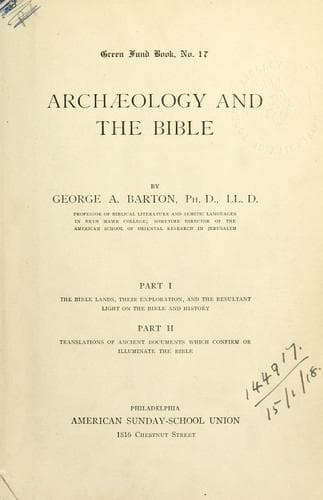
Archæology and the BibleBarton, George A. (George Aaron)
Religion
Archæology and the Bible
Barton, George A. (George Aaron)
Bible -- Antiquities; Egypt -- Antiquities; Middle East -- Antiquities
At all events, in the struggles that ensued, little by little all
allegiance to Egypt was thrown off by the Palestinians. Letters to Egypt
ceased to be written, our sources fail us, and for more than forty years
we can only conjecture what was happening in Palestine.
(3) _Seti I._--With the accession of Seti I of the nineteenth Egyptian
dynasty, who ruled from 1313 to 1292 B. C., some knowledge of events in
Palestine begins once more to come to us. Seti in his first year entered
Asia, captured an unnamed walled town on the border of the desert, pushed
northward and took the towns in the Plain of Jezreel, crossed the Jordan
and conquered cities in the Hauran, where he set up a pillar, discovered
there a few years since by Principal George Adam Smith; he then turned
west and conquered a city on the slopes of the Lebanon mountains.[113]
This campaign regained for Egypt all of Palestine and southern Phœnicia.
In his third year Seti was again in Asia. On this campaign he overthrew
the kingdom of the Amorites in northern Galilee. They occupied the city of
Kedesh in Naphtali (Josh. 19:37). This city Seti besieged and took.
(4) _Ramses II._--Thus at the beginning of the reign of Ramses II, who
ruled from 1292-1225 B. C., all Palestine was subject to Egypt. The
practical defeat of Ramses by the Hittites at Kadesh on the Orontes in his
fifth year, however, caused all Palestine to revolt, and Ramses was
compelled to undertake the reconquest of the land. This he accomplished
between his fifth and eighth years, beginning with the Philistine cities
and overrunning the whole country to the Hauran, where he set up a pillar,
as his father had previously done.[114] So far as we know, Palestine
remained quietly under the rule of Ramses during the remainder of his long
reign.
Ramses II, like Thothmes III, left on record a long list of cities
conquered by him in Asia. Of these the following are Palestinian towns
mentioned in the Bible:[115] Hammath (Josh. 19:35), Beth-shean (Josh.
17:11), Beth-anath (Josh. 19:38), and Hadasha (Josh. 15:37). Pella, a town
in the Jordan valley not mentioned in the Bible, also occurs in his list,
and there is also a possible mention of Jacobel in a corrupted form.
(5) _Merneptah._--After the accession of Merneptah, the successor of
Ramses II, a rebellion broke out. This was about 1223 B. C. Merneptah put
down the rebellion, but in the struggle caused by it, he was compelled to
reduce Gezer by siege. It was on this campaign that he came into contact
with Israel and defeated her.[116] Some think the Israelites whom he
mentioned were those who more than a century and a quarter before had been
battling against Jerusalem; others, that they were those who had just
escaped from Egypt.
Public-domain text, read in full here on John Shaqi.
Reviews
Reviews
No reviews yet
Be the first to share your thoughts on this work.
Elsewhere in the archive
Join the Discussion
Join the discussion
Sign in to leave a comment or review.
Sign InorCreate an account