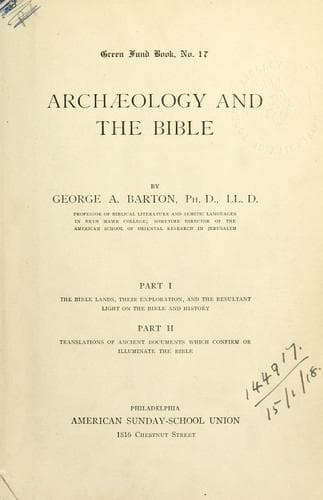
Archæology and the BibleBarton, George A. (George Aaron)
Religion
Archæology and the Bible
Barton, George A. (George Aaron)
Bible -- Antiquities; Egypt -- Antiquities; Middle East -- Antiquities
In size and shape the vessels presented a great variety. There were large
jars with flat bottoms, inverted conical bodies, and more or less abruptly
rounded shoulders; (see Fig. 100). The mouth was wide and circular and
surrounded by a flat, widely expanding rim. These jars averaged about two
feet in height. There were many pitchers made in this period. They were
large and small and of a great variety of shapes. Such pitchers present
similar characteristics, whether found at Gezer or Megiddo; (see Figs. 98,
99). Ledge and loop handles were common on the pitchers of this period,
but “pillar” and “button”[172] handles were also sometimes found; (see
Figs. 105, 106). The ornamentation of pottery showed some advance over the
preceding period. In addition to the rope motifs, decoration formed by
combinations of lines was also found. One particularly fine type of
pottery belonging to this period was found at Gezer. It was never found in
the caves or in the higher strata. Vessels of this ware were usually found
in groups, indicating that they were the possessions of the rich. The clay
was well cleaned, the shapes distinctive (see Fig. 104), and the ware was
always covered with a cream-like coating. Saucers and bowls were common in
this period. The comb was still used in ornamenting pottery, though
sometimes it produced only a series of dots. All surfaces were usually
burnished, though naturally this was much more thoroughly done in the
expensive than in the cheaper wares.
=4. Pottery of Second Semitic Period.=--During the second Semitic period,
1800-1400 B. C., trade was carried on with countries beyond the sea,
especially with Cyprus. There was probably also some trade with Egypt and
Crete, but the influence of Cyprus was most potent in the pottery. In this
period, probably owing to foreign influence, the potters’ wheel worked by
foot was introduced. This left both hands of the workman free and resulted
in a great improvement of the ware. There was in this period a great
variety in the material used. The cheaper vessels were made of a rough
clay, full of grits of black colored sand or flints, which burned black in
the middle of the clay and a reddish or yellowish drab on the surface. At
least seven other finer types of ware were found at Gezer.[173] One of
these was a ware made of a brilliant saffron-yellow clay, which was
enriched with painted decoration in bold black lines. This was probably of
foreign origin. In this period the jar with pointed bottom, long conical
body, well rounded shoulders, short concave neck, continuous circular
mouth, with an expanded rim, though much narrower than in the preceding
period, is the most common type. Jugs with pointed bottoms also became
common, though there was a great variety in the shapes of jugs. Ledge
handles had almost entirely disappeared in this period. Jars generally had
two loop handles, and sometimes four, though occasionally they had none at
all.
Public-domain text, read in full here on John Shaqi.
Reviews
Reviews
No reviews yet
Be the first to share your thoughts on this work.
Elsewhere in the archive
Join the Discussion
Join the discussion
Sign in to leave a comment or review.
Sign InorCreate an account