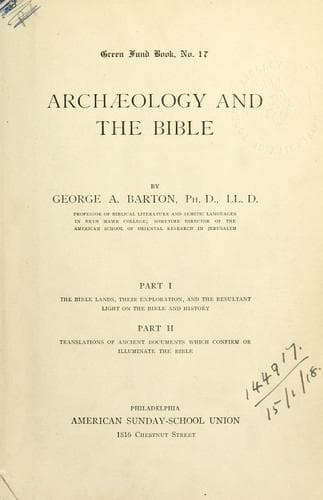
Archæology and the BibleBarton, George A. (George Aaron)
Religion
Archæology and the Bible
Barton, George A. (George Aaron)
Bible -- Antiquities; Egypt -- Antiquities; Middle East -- Antiquities
“Button” handles are comparatively uncommon; the loop handle is the
style most generally used. “Ear” handles, both vertical and transverse,
are also common; (see Figs. 101-103, and 105).
The most striking feature of the pottery of this period is the increase in
the variety of ornamentation and the introduction of the pictures of
animals and birds as ornamental motifs. This was due, no doubt, to foreign
influence. The best specimens of this type of ornamentation so far
published are from Gezer, though it is found elsewhere.
All kinds of vessels were made of clay during this period: jars, jugs,
pitchers, bowls, saucers, drinking-cups, etc., etc. Many of the potters
signed their work with a peculiar mark. This mark was sometimes an
impression of the potter’s finger, sometimes linear devices of various
kinds scratched on the handle, and sometimes the impression of an
inscribed Egyptian scarab, usually of the period of the Middle Kingdom or
the Hyksos time. Jar handles marked with scarabs were also found at
Jericho; (Figs. 118, 119).
=5. Third Semitic Period.=--The third Semitic period, 1400 to 1000 B. C.,
while its wares sometimes differed in form from those of the preceding
period, is mainly marked off from the second period by a general
degeneration in style. No great differences are noticeable in the kinds of
clay employed. The jars have, as a rule, a less pointed bottom than in the
preceding period; (Fig. 110). The combed decoration is rare, and the
burnishing of the jars is both less frequent and less skilful than in the
preceding period. There is an increase in the tendency to use painted
ornamentation, which frequently consists of zigzag lines. Rough,
conventionalized representations of palm trees are also common. In the
last part of the period Cretan influences are traceable. This was probably
due to the coming of the Philistines.[174] Potters’ marks continue, but
scarabs are less often used in making them than in the preceding period.
The various kinds of vessels made seem to have been as great as in the
preceding period. A clay funnel or bottle-filler was also found in this
period; (see Fig. 114).
Public-domain text, read in full here on John Shaqi.
Reviews
Reviews
No reviews yet
Be the first to share your thoughts on this work.
Elsewhere in the archive
Join the Discussion
Join the discussion
Sign in to leave a comment or review.
Sign InorCreate an account