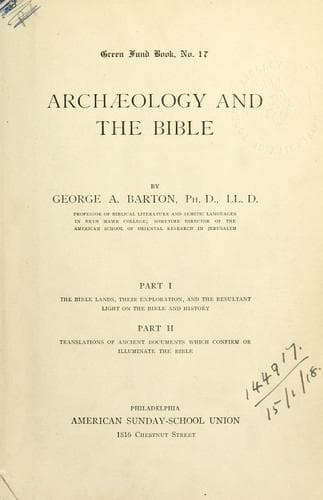
Archæology and the BibleBarton, George A. (George Aaron)
Religion
Archæology and the Bible
Barton, George A. (George Aaron)
Bible -- Antiquities; Egypt -- Antiquities; Middle East -- Antiquities
9. [Then arose] Nin-igi-azag, two small creatures [he created],
10. In the assembly of the beasts he made [their form] brilliant,
11. .......... the goddess Gula ..........
12. ................ one white and one black ..........
13. ............ one white and one black ..........
The Babylonian account, then, contained somewhere the story of the
creation of the animals, though, like the other parts of the Babylonian
account, its order and atmosphere differ widely from the Biblical
narrative.
Some of these resemblances are of no great significance. The fact that the
two accounts are arranged by sevens may be due simply to the fact that
that number was sacred among both peoples. It is thought by some scholars
that its use in Genesis was consciously adopted in order to lead up to the
sabbath and glorify it. This might be true, even if the writer of the
chapter knew of the Babylonian arrangement by sevens.
The features of the two narratives, which have convinced some scholars of
all shades of opinion that there is a real kinship between the two
accounts, are their agreement as to the nature of primeval chaos, and the
division of the primeval ocean by a firmament for the creation of the
heavens and the earth. Both writers had, so to speak, the same raw
material of objective conceptions.
The differences between the accounts are, however, most marked. To speak
first of that which is least important, the Hebrew order is in many
respects different from the Babylonian. In the Babylonian the gods are
generated in the first tablet, the world is not created till the fourth,
and the creation of all other things is told in tablets four, five, and
six. In other words, creation is divided into two parts, each of which is
told in three tablets. The first three tablets deal with gods, the second
three with the world and living things.
Public-domain text, read in full here on John Shaqi.
Reviews
Reviews
No reviews yet
Be the first to share your thoughts on this work.
Elsewhere in the archive
Join the Discussion
Join the discussion
Sign in to leave a comment or review.
Sign InorCreate an account