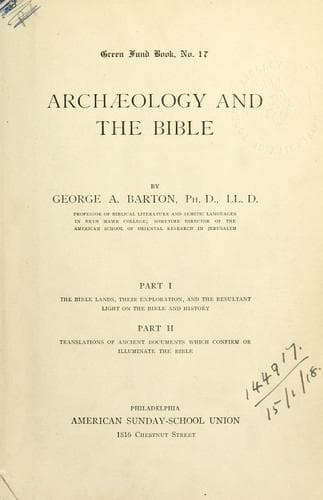
Archæology and the BibleBarton, George A. (George Aaron)
Religion
Archæology and the Bible
Barton, George A. (George Aaron)
Bible -- Antiquities; Egypt -- Antiquities; Middle East -- Antiquities
The Babylonian poem, crude though it seems to us, had a powerful
fascination for the imagination. With more or less distinctness parts of
it seem to have been known to various Hebrew writers, who, attributing to
their own God, Jehovah, the rôle ascribed in the epic to Marduk, used
these stories as poetic illustrations. At least this is the view of a
considerable group of scholars. Some object that, if this were true, it
would degrade Jehovah to the level of Marduk, but the objection does not
seem well founded. The Hebrews might well have been such ardent
monotheists as to believe that each and every mighty manifestation of
power had been the work of Jehovah, without in any way lowering Jehovah to
the level of a heathen god. The most important parallels which have been
cited are here given, so that the reader may judge for himself as to which
view is the more probable.
In Job 9:13, 14 we read:
God will not withdraw his anger;
The helpers of Rahab do stoop under him.
How much less shall I answer him,
And choose out my words to reason with him?
Rahab is believed by many to be here an epithet of Tiâmat. It means “the
one who acts boisterously” or “proudly.” Those who thus think believe the
lines in Job to refer to the overcoming of Tiâmat’s helpers in Tablet IV,
lines 105-118, of the Babylonian creation epic, which read as follows:
After Tiâmat the leader he had slain,
Her army he broke, her host was scattered,
And the gods, her helpers, who marched at her side,
Trembled, feared, they turned their backs;
They sought an exit, to save their lives;
With a cordon they were encompassed, escape was not possible.
He caught them, their weapons he broke,
Into the net they fell, in the snare they remained.
All the quarters of the world they filled with their lamentation.
His wrath they endured, they were held in bondage.
And the eleven creatures, whom she had filled with terribleness,
The troop of demons who marched as her helpers,
He threw into fetters, their power he broke;
Along with their opposition he trampled them under his feet.
This would seem to suit the reference in Job, and to give point to Job’s
words. As our Saviour used stories in his parables, so this poet may have
used this well-known story to illustrate his point.
Again Job 26:12, 13 reads:
He stirreth up the sea with his power,
And by his understanding he smiteth through Rahab.
By his Spirit the heavens are garnished;
His hand hath pierced the swift serpent.
Four of the ancient versions of the Old Testament, with a very slight
change in the Hebrew letters, read Job 26:13:
The bars of heaven fear him;
His hand hath pierced the swift serpent.
Into comparison with v. 12 and the last line of 13, scholars have brought
Tablet IV, line 93, ff., which runs:
Public-domain text, read in full here on John Shaqi.
Reviews
Reviews
No reviews yet
Be the first to share your thoughts on this work.
Elsewhere in the archive
Join the Discussion
Join the discussion
Sign in to leave a comment or review.
Sign InorCreate an account