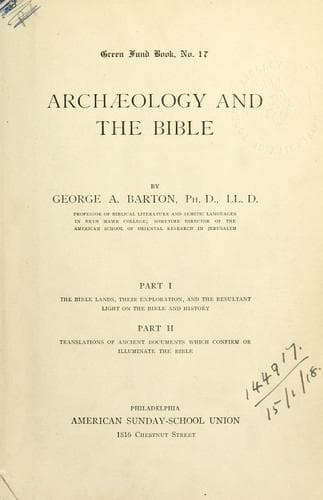
Archæology and the BibleBarton, George A. (George Aaron)
Religion
Archæology and the Bible
Barton, George A. (George Aaron)
Bible -- Antiquities; Egypt -- Antiquities; Middle East -- Antiquities
Then took their stand, Tiâmat and the leader of the gods, Marduk;
For the fight they approached, for the battle drew near.
The lord spread out his net and enclosed her,
The evil wind from behind he thrust into her face.
As Tiâmat opened her mouth to its full extent,
The evil wind he drove in, so that her lips could not close.
With the mighty winds he filled her belly.
Her courage was taken away, and she opened her mouth.
He let fall the spear, he burst open her belly,
He cut through her inward parts, he pierced her heart,
He bound her and her life destroyed;
Her body he cast down and stood upon it.
Into comparison with the first line of v. 13, as the versions give it,
scholars have brought line 135, and ff., of the same tablet:
Then the lord rested, he gazed upon her body,
The flesh of the monster he divided; he formed a cunning plan.
He split her open like a flat fish into two halves;
One half of her he established and made a covering of the heavens.
He drew a bolt, he established a guard,
And not to let her waters come out, he commanded.
With the passages quoted above Psa. 74:13, 14 has also been compared:
Thou didst divide the sea by thy strength:
Thou brakest the heads of the sea-monsters in the waters.
Thou brakest the heads of leviathan in pieces;
Thou gavest him to be food to the people inhabiting the wilderness.
Verses 16, 17 of the same Psalm continue the theme with the words:
The day is thine, the night also is thine:
Thou hast prepared the light and the sun.
Thou hast set all the borders of the earth:
Thou hast made summer and winter.
The theme is the same as that of the epic, viz.: the creation of the
world. It would appear from v. 14 that as the Hebrews called Tiâmat
Rahab, so they called Kingu leviathan. Those who so think find another
reference to the Babylonian creation epic in Job 3:8:
Let them curse it that curse the day,
Who are ready to rouse up leviathan.
Apparently there were magicians who professed to be able to arouse such a
monster.
Other references to leviathan are thought to employ the same illustrative
material. Thus in Isa. 27:1 we read:
In that day Jehovah with his hard and great and strong sword will
punish leviathan the swift serpent, and leviathan the crooked serpent;
and he will slay the monster that is in the sea.
In Job 41 there is a long description of the crocodile under the name
leviathan. In verses 19-21 some things are said of him that do not suit a
real crocodile, and some scholars have thought that the language was
influenced by the Babylonian material. These verses are:
Out of his mouth go burning torches,
And sparks of fire leap forth.
Out of his nostrils a smoke goeth,
As of a boiling pot and burning rushes.
His breath kindleth coals,
And a flame goeth forth from his mouth.
Other references to Rahab, which have been thought to use the same
illustration, are Psalm 89:10:
Public-domain text, read in full here on John Shaqi.
Reviews
Reviews
No reviews yet
Be the first to share your thoughts on this work.
Elsewhere in the archive
Join the Discussion
Join the discussion
Sign in to leave a comment or review.
Sign InorCreate an account