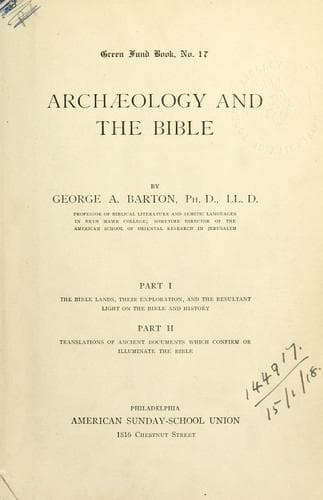
Archæology and the BibleBarton, George A. (George Aaron)
Religion
Archæology and the Bible
Barton, George A. (George Aaron)
Bible -- Antiquities; Egypt -- Antiquities; Middle East -- Antiquities
Thou hast broken Rahab in pieces as one that is slain;
Thou hast scattered thine enemies with the arm of thy strength.
Also, Isaiah 51:9:
Is it not thou that didst cut Rahab in pieces,
That didst pierce the monster?
As to whether these sacred writers really employed the material of the
Babylonian epic to give force to their illustrations, the judgments of men
will differ in accordance with their views of what is possible for an
inspired writer.
In the following passages Rahab is used to denote Egypt as a proud and
imperious country. These uses are clearly figurative and metaphorical.
Isa. 30:7:
For Egypt helpeth in vain and to no purpose:
Therefore have I called her Rahab that sitteth still.
Psa. 87:4:
Rahab and Babylon I proclaim my votaries.
A fragmentary account of an Assyrian version of the creation epic has been
found. It agrees with the Babylonian account in beginning with Tiâmat,
though the course of creation appears to have been different. The tablets
known to us present it, however, in a form too fragmentary for us to
follow the course of the narrative.
CHAPTER II
ANOTHER ACCOUNT OF THE CREATION FOUND AT BABYLON.[364]
TEXT OF THE ACCOUNT. COMPARISON OF IT WITH GENESIS 2.
=1. Text of the Account.=
1. A holy house, a house of the gods, in a holy place had not been
made;
2. No reed had sprung up, no tree had been created.
3. No brick had been made, no foundation had been built,
4. No house had been constructed, no city had been built;
5. No city had been built, thrones had not been established;
6. Nippur had not been constructed, Ekur had not been built;
7. Erech had not been constructed, Eanna had not been built;
8. The deep had not been formed, Eridu had not been built;
9. The holy house, the house of the gods, the dwelling had not been
made,--
10. All lands were sea,--
11. Then in the midst of the sea was a water-course;
12. In those days Eridu was constructed, Esagila was built,
13. Esagila where, in the midst of the deep, the god Lugal-dul-azaga
abode,
14. (Babylon was made, Esagila was completed).
15. The gods and the Anunaki he made at one time.
16. (The holy city, the dwelling of their hearts’ desire, they named
as first),
17. Marduk bound a structure of reeds upon the face of the waters,
18. He formed dust, he poured it out beside the reed-structure.
19. To cause the gods to dwell in the habitation of their hearts’
desire,
20. He formed mankind.
21. The goddess Aruru with him created mankind,
22. Cattle of the field, in whom is breath of life, he created.
23. He formed the Tigris and Euphrates and set them in their places,
24. Their names he did well declare.
25. The grass, marsh-grass, the reed and brushwood (?) he created,
26. The green grass of the field he created,
27. The land, the marshes, and the swamps;
Public-domain text, read in full here on John Shaqi.
Reviews
Reviews
No reviews yet
Be the first to share your thoughts on this work.
Elsewhere in the archive
Join the Discussion
Join the discussion
Sign in to leave a comment or review.
Sign InorCreate an account