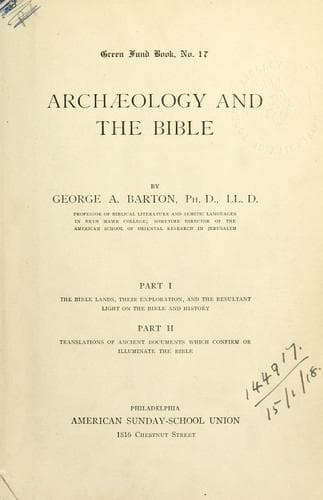
Archæology and the BibleBarton, George A. (George Aaron)
Religion
Archæology and the Bible
Barton, George A. (George Aaron)
Bible -- Antiquities; Egypt -- Antiquities; Middle East -- Antiquities
While these points of likeness are evident, there are great differences
between the two narratives. The Babylonian account speaks not only of
grass and reeds as non-existent, but of cities and temples also, which, it
tells us, were created later. It has no picture of Eden; its thought
centers in well-known Babylonian cities. While Marduk appears as supreme
in the Babylonian poem, the gods and Anunaki, or spirits of earth, are
recognized, so that the polytheistic view is not entirely absent. In the
Biblical picture, on the other hand, Jehovah is supreme. Opinions of
scholars differ as to whether there was any real connection between the
two narratives. Whatever opinion one may hold on this point, there can be
no question but that the second chapter of Genesis is dominated by those
religious conceptions which were so uniquely manifested in Israel, while
they are absent from the Babylonian narrative.
(_For a new Babylonian account of the creation of man, see Appendix._)
CHAPTER III
THE BABYLONIAN SABBATH
FEAST OF MARDUK AND ZARPANIT. A DAY CALLED SHABATUM. A DAY IN SOME
TABLETS AT YALE.
=1. Feast of Marduk and Zarpanit.=
The seventh day is the feast of Marduk and Zarpanit. It is an evil
day. The shepherd of the great people shall not eat flesh cooked on
the coals which is smoked. The garment of his body he shall not
change; a clean one he shall not put on. A sacrifice he shall not
offer. The king in a chariot shall not ride. In triumph he shall not
speak. In the secret place a seer shall not give an oracle. The
physician shall not lay his hand on the sick. It is not fitting to
utter a malediction. At night before Marduk and Ishtar the king shall
bring his offering; a libation he shall pour out. The lifting up of
his hands shall then be pleasing to the gods.[365]
This passage occurs in a tablet which describes the nature of all the days
of a month. The same prohibitions are recorded for the fourteenth,
nineteenth, twenty-first, and twenty-eighth days. The tablet has often
been brought into comparison with the Hebrew sabbath, partly because the
seventh, fourteenth, twenty-first, and twenty-eighth days are involved,
partly because the prohibitions remind the reader of Exodus 20:8-11 and
Deut. 5:12-15.
Exod. 20:8-11. Remember the sabbath day, to keep it holy. Six days
shalt thou labor, and do all thy work: but the seventh day is a
sabbath unto the Lord thy God: _in it_ thou shalt not do any work,
thou, nor thy son, nor thy daughter, thy manservant, nor thy
maidservant, nor thy cattle, nor thy stranger that is within thy
gates: for in six days the Lord made heaven and earth, the sea, and
all that in them is, and rested the seventh day: wherefore the Lord
blessed the sabbath day, and hallowed it.
Public-domain text, read in full here on John Shaqi.
Reviews
Reviews
No reviews yet
Be the first to share your thoughts on this work.
Elsewhere in the archive
Join the Discussion
Join the discussion
Sign in to leave a comment or review.
Sign InorCreate an account