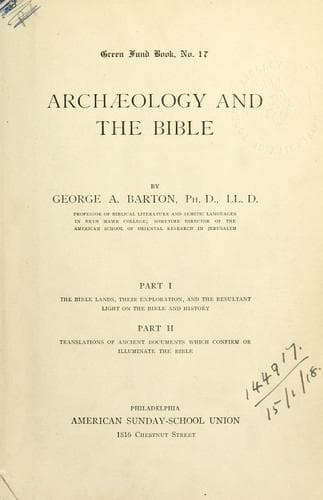
Archæology and the BibleBarton, George A. (George Aaron)
Religion
Archæology and the Bible
Barton, George A. (George Aaron)
Bible -- Antiquities; Egypt -- Antiquities; Middle East -- Antiquities
Deut. 5:12-15. Observe the sabbath day, to keep it holy, as the Lord
thy God commanded thee. Six days shalt thou labor, and do all thy
work: but the seventh day is a sabbath unto the Lord thy God: _in it_
thou shalt not do any work, thou, nor thy son, nor thy daughter, nor
thy manservant, nor thy maidservant, nor thine ox, nor thine ass, nor
any of thy cattle, nor thy stranger that is within thy gates; that thy
manservant and thy maidservant may rest as well as thou. And thou
shalt remember that thou wast a servant in the land of Egypt, and the
Lord thy God brought thee out thence by a mighty hand and by a
stretched out arm: therefore the Lord thy God commanded thee to keep
the sabbath day.
In reality the Babylonian prohibitions apply to certain classes of people
only, and not to the whole population. A study of the contract literature
shows that there was no cessation of business upon these days of the
month, so that resemblance to the Hebrew sabbath is really quite slight.
=2. A Day Called Shabatum.=
These days were not, so far as we know, called _shabatum_, but another
tablet[366] tells us that the fifteenth day of each month was so called.
_Shabatum_ is etymologically the same as the Hebrew sabbath. As the
Babylonian months were lunar, the fifteenth was the time of the full moon,
so that in Babylonian the day denoted the completion of the moon’s growth.
In the Old Testament “sabbath” is sometimes coupled with “new moon,” as
though it may also have designated a similar day. (See 2 Kings 4:23; Amos
8:5; Hosea 2:11; Isa. 1:13; 66:23, and Ezek. 46:3.) This Babylonian
_shabatum_ can, in any event, have no direct relationship to the Hebrew
sabbath as a day of rest once a week.
=3. A Day in Some Tablets at Yale.=
A series of tablets in the Yale Babylonian Collection, a portion of which
has been published by Prof. Clay,[367] shows that special sacrifices were
offered on the seventh, fourteenth, twenty-first, and twenty-eighth of
each month. These sacrifices show that these days were thought to have
some peculiar significance, but, whatever that significance may have been,
the evidence cited shows that it was not the same as that of the Hebrew
sabbath.
CHAPTER IV
THE LEGEND OF ADAPA AND THE FALL OF MAN
COMPARISON WITH GENESIS 3. THE ADAPA MYTH.
Four fragments of the Adapa myth have been found. They really present but
three parts of the story, as two of them cover the same ground. These
three parts of the story are translated in this chapter. It will be noted
that the fragments do not present the entire story. Between fragments I
and II, as well as between fragments II and III, some lines have fallen
out, and the last fragment is broken away before the end of the account is
reached. Nevertheless, from the parts which we have it is clear that the
Babylonians shared with the Hebrews some of the traditions recorded in the
third chapter of Genesis.
=1. Comparison with Genesis 3.=
Public-domain text, read in full here on John Shaqi.
Reviews
Reviews
No reviews yet
Be the first to share your thoughts on this work.
Elsewhere in the archive
Join the Discussion
Join the discussion
Sign in to leave a comment or review.
Sign InorCreate an account