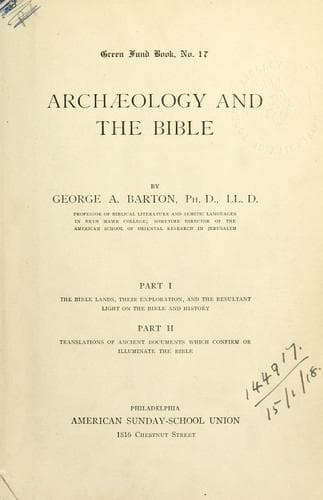
Archæology and the BibleBarton, George A. (George Aaron)
Religion
Archæology and the Bible
Barton, George A. (George Aaron)
Bible -- Antiquities; Egypt -- Antiquities; Middle East -- Antiquities
It should be further noted that these documents represent a complete
conquest of Babylon by Elam--a conquest in which Babylon itself is laid
desolate. It is not certain just what part Dursil-ilâni played in the
story. He may have been a vassal king under Kukukumal, or the Babylonian
upon whom the hopes of the people centered, to free them from the yoke of
Elam. It is clear, however, that the events mentioned in these documents
are not in harmony with the supposition that these monarchs acted as
allies of Hammurapi in the invasion of Palestine. Hammurapi is excluded
from the account. Kukukumal conquered and desolated the very city in which
Hammurapi had his throne. Kukukumal must, accordingly, have lived at some
other period of the history, and the supposed confirmation of the account
of the fourteenth chapter of Genesis has not yet been found.
As already stated, these tablets are not earlier than the fourth century
B. C. The events which they record were probably much later than the time
of Abraham. Babylon is called by its Cassite name, Kar-duniash, a name
which it did not bear until some hundreds of years after the time of
Hammurapi. Many times in the course of Babylonian history was the country
overrun by Elam, and there is no real reason to suppose that the war here
referred to belongs to the age of Hammurapi.
CHAPTER X
JACOB AND JOSEPH
APPEARANCES OF THESE NAMES IN BABYLONIAN AND EGYPTIAN RECORDS. “THE
TALE OF THE TWO BROTHERS”; ITS BEARING ON THE STORY OF JOSEPH IN
GENESIS. LETTERS TO A RULER LIKE JOSEPH. THE SEVEN YEARS OF FAMINE.
INSCRIPTION SHOWING PREPARATION FOR FAMINE.
=1. Jacob.=
Three different men in Babylonia at the time of the Hammurapi dynasty bore
the name Jacob-el. Thus, in the reign of Apil-Sin, the fourth king of the
dynasty (2161 to 2144 B. C.), two witnesses, Shubna-ilu and Yadakh-ilu
gave their father’s name as _Yakub-ilu_, or Jacob-el.[427] In the same
reign a witness to another document, one Lamaz, had a Jacob-el as his
father.[428] In the reign of Sin-muballit, the next king, a witness named
Nur-Shamash was also the son of a Jacob-el.[429] In the reign of the great
Hammurapi, the next king, a witness named Sin-erbiam gave his father’s
name simply as _Yakub_,[430] or Jacob. This last is clearly a shortening
of Jacob-el. These men all lived from 75 to 190 years before the
Babylonian Abraham, whose documents are discussed in Chapter IX.
Public-domain text, read in full here on John Shaqi.
Reviews
Reviews
No reviews yet
Be the first to share your thoughts on this work.
Elsewhere in the archive
Join the Discussion
Join the discussion
Sign in to leave a comment or review.
Sign InorCreate an account