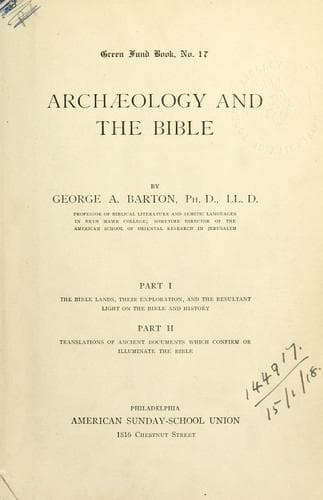
Archæology and the BibleBarton, George A. (George Aaron)
Religion
Archæology and the Bible
Barton, George A. (George Aaron)
Bible -- Antiquities; Egypt -- Antiquities; Middle East -- Antiquities
In connection with these names it should be noted that Thothmes III of
Egypt, who made extensive conquests in Asia between 1478 and 1446 B. C.,
records the name of a city which he captured in Palestine as
_Ya-‘-k-b’-ra_, the Egyptian equivalent of Jacob-el.[431] It does not seem
a rash guess to suppose that in the period when intercourse between
Babylonia and Palestine was frequent and immigration from the former
country to the latter was in progress, some Babylonian bearing this name
migrated to Palestine, settled there and that a city was named after him.
Many parallels to this may be found in the names of places in the United
States and Canada. That this place name in Canaan had some connection with
the name of the Patriarch Jacob is probable, though just what that
connection was it is impossible in the present state of our knowledge to
say.
=2. Joseph.=
A Babylonian business document of the time of the first dynasty of Babylon
has among its witnesses a man named _Yashub-ilu_, or Joseph-el.[432]
In the list of places which Thothmes III of Egypt conquered in Palestine
there is one _Ya-sha-p’-ra_, which many scholars have taken to be
Joseph-el, though Prof. W. Max Müller[433] thinks it rather is equivalent
to Yesheb-el, meaning “where God dwells.” In view of the clear Babylonian
equivalence, however, it seems probable that it is Joseph-el. If so, it
probably became a place-name in Palestine because some important
Babylonian who bore the name settled there, just as we have supposed
Jacob-el did. Some scholars hold that it is connected with the name of the
Patriarch Joseph in some way, but what that connection was, we cannot now
say.
=3. The Tale of the Two Brothers.=[434]
Once there were two brethren, of one mother and one father; Anpu was
the name of the elder, and Bata was the name of the younger. Now, as
for Anpu, he had a house, and he had a wife. But his little brother
was to him, as it were, a son; he it was who made for him his clothes;
he it was who followed behind his oxen to the fields; he it was who
did the plowing; he it was who harvested the corn; he it was who did
for him all the matters which were in the field. Behold his younger
brother grew to be an excellent worker; there was not his equal in the
whole land; behold the spirit of a god was in him.
Public-domain text, read in full here on John Shaqi.
Reviews
Reviews
No reviews yet
Be the first to share your thoughts on this work.
Elsewhere in the archive
Join the Discussion
Join the discussion
Sign in to leave a comment or review.
Sign InorCreate an account