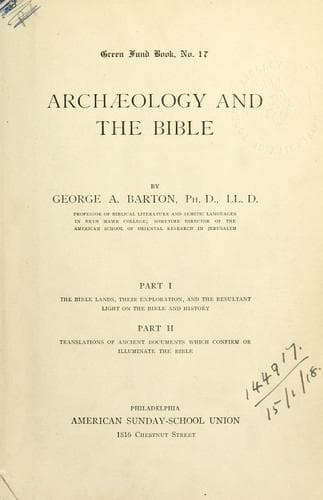
Archæology and the BibleBarton, George A. (George Aaron)
Religion
Archæology and the Bible
Barton, George A. (George Aaron)
Bible -- Antiquities; Egypt -- Antiquities; Middle East -- Antiquities
The greatest aid in fixing Egyptian chronology is the “Sothic Cycle.” At
an early date the Egyptians adopted a calendar which made up a year of 365
days. Their year originally began when the rapid rising of the Nile
coincided with the rising of the star Sirius, called by them Sothis. These
events coincided on July 19th. As their calendar made no allowance for
leap year, in four years their new year began a day too soon, in eight
years two days too soon, and so on. In 1,460 years (_i. e._, 365 × 4)
their New Year’s Day would make a complete circuit of the year. These
periods of 1,460 years are called Sothic Cycles. Censorinus, in Chapters
XVIII and XXI of his _De Die Natali_, written in 238 A. D., tells us that
a new Sothic cycle began at some time between 140 and 144 A. D. If a new
cycle began in 140 A. D., the previous one began in 1320 B. C.; the one
before that, in 2780 B. C.; and the one before that,--if they had their
calendar so early,--in 4240 B. C. Reisner holds that the Egyptians adopted
their calendar in 2780 B. C., but Meyer and Breasted hold that it is
unthinkable that they should have been without a calendar until that time,
as by that date the civilization of the pyramid builders was at its
height; they accordingly maintain that the Egyptian calendar was adopted
in 4240 B. C.
An illustration will show how the Sothic cycle helps in determining dates.
A priest in the 120th year of the twelfth dynasty wrote a letter to his
subordinates, to inform them that the rising of Sothis would occur on the
fifteenth day of the eighth month. As there were thirty days in each
month, the year diverged at this time 225 days. This date, then, was just
900 years after the beginning of the cycle in 2780 B. C.; _i. e._, the
letter was written in the year 1880 B. C. It proves that the twelfth
dynasty began in 2000 B. C., and fixes for us all the dates of that
dynasty. The calendar in the so-called _Papyrus Ebers_ shows that in the
tenth year of Amenophis I, of the eighteenth dynasty, the divergence had
increased to 308 days. This must have been 1,232 years after the beginning
of the cycle, which was the year 1548 B. C. Data gained from these sources
are supplemented by what is called dead reckoning; _i. e._, by adding
together all the specific dates of the length of reigns which are given in
the inscriptions, and testing them by collateral references. Meyer and
Breasted have worked out the chronology from these data in this way. Meyer
places the accession of Mena at 3200 B. C., while Breasted places it at
3400 B. C. This difference is slight when compared with the differences in
the chronologies of the older Egyptologists.
=6. Outline of History.=[3]--The history of Egypt, as it concerns our
subject, extends over a period of five thousand years. It falls into
twelve periods:
Public-domain text, read in full here on John Shaqi.
Reviews
Reviews
No reviews yet
Be the first to share your thoughts on this work.
Join the Discussion
Join the discussion
Sign in to leave a comment or review.
Sign InorCreate an account