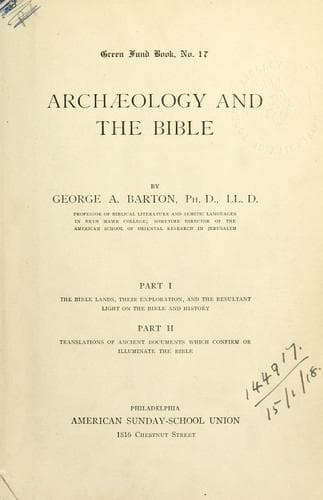
Archæology and the BibleBarton, George A. (George Aaron)
Religion
Archæology and the Bible
Barton, George A. (George Aaron)
Bible -- Antiquities; Egypt -- Antiquities; Middle East -- Antiquities
17. my lord, I shall not depart.
18. My lord, truly Khatib
19. stands with me.
20. I and he will come.
21. My lord, the king of the Hittites
22. has come into Nukhashshi,
23. so that I cannot come.
24. Would that the king of the Hittites would depart!
25. Then truly I would come,
26. I and Khatib.
27. May the king, my lord, my words
28. hear! My lord, I fear
29. on account of the face of the king, my lord,
30. and on account of the face of Dûdu.
31. And now by my gods
32. and my angels verily I have sworn,
33. O Dûdu and nobles
34. of the king, my lord, that truly I will come.
35. And so, Dûdu
36. and the king, my lord, and the nobles,
37. “Truly we will not conceive anything
38. against Aziru that is unfavorable,”--
39. even thus may ye swear
40. by my gods and the god A!
41. And truly I
42. and Khatib are faithful servants of the king.
43. O Dûdu, thou shalt truly know
44. that I will come to thee.
The Aziru of these letters was the chieftain or petty king of the
Amorites, who were living at the time to the eastward of Phœnicia, between
the Lebanon and Anti-Lebanon mountains. The way in which he addresses Dûdu
is significant. Dûdu is classed continually with the king. Aziru fears to
offend Dûdu as he fears to offend the king; the words of Dûdu are of equal
importance with those of the king. Dûdu clearly occupied a position of
power with the king of Egypt similar to that ascribed to Joseph in Genesis
41. Moreover, Dûdu is a Semitic name; vocalized a little differently, it
becomes David.
The king to whom this letter was written was Amenophis III or Amenophis
IV, in whose reigns Semitic influence was especially strong in Egypt.
Amenophis III took as his favorite wife a woman named Tiy, daughter of
Yuaa and Tuau, whose mummies, discovered a few years ago, show, some
think, that they were Semitic. Queen Tiy was very influential during the
reign of her son, Amenophis IV, and was in part the cause of the
remarkable religious reform which he undertook (Part I, Chapter I, § 6
(vii)). It is not, accordingly, strange to find that the chief minister of
one of these kings was a Semite. Of course, Dûdu cannot be identified with
Joseph, but his career shows that such careers as that of Joseph were not
impossible at this period of Egyptian history.
=5. The Seven Years of Famine.=
The following inscription was found cut on a rock between the island of
Elephantine and the First Cataract, and was first published by Brugsch in
1891. It is written in hieroglyphic characters, and was apparently
inscribed in the reign of Ptolemy X, 117-89 B. C. It relates how King
Zoser, of the third dynasty, who began to reign about 2980 B. C., nearly
2,800 years before the inscription was written, appealed to Khnum, the god
of Elephantine, because of a famine. The part of the text which interests
us is as follows:[439]
Public-domain text, read in full here on John Shaqi.
Reviews
Reviews
No reviews yet
Be the first to share your thoughts on this work.
Elsewhere in the archive
Join the Discussion
Join the discussion
Sign in to leave a comment or review.
Sign InorCreate an account