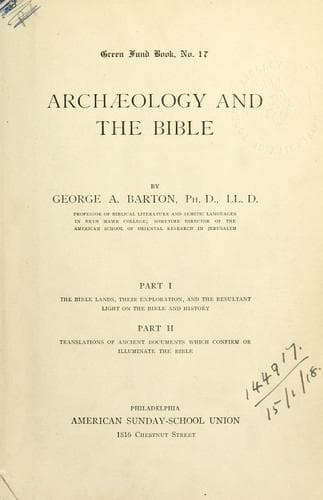
Archæology and the BibleBarton, George A. (George Aaron)
Religion
Archæology and the Bible
Barton, George A. (George Aaron)
Bible -- Antiquities; Egypt -- Antiquities; Middle East -- Antiquities
§ 2. If a man accuses another of practising sorcery upon him, but has
not proved it, he against whom the charge of sorcery is made shall go
to the sacred river; into the sacred river he shall plunge, and if the
sacred river overpowers him, his accuser shall take possession of his
house. If the sacred river shows that man to be innocent, and he is
unharmed, he who charged him with sorcery shall be killed. He who
plunged into the sacred river shall take the house of his accuser.
With these laws we should compare Exod. 22:18, which imposes the death
penalty upon witches, and Deut. 18:10, ff., which declares that there
shall be no sorcerer, diviner, magician, or charmer in Israel and promises
a line of prophets to render these unnecessary. Magic is banished from
Israel; its presence in Babylonia is taken for granted, and only some of
its exercises, which were supposed to be especially deadly, were
forbidden. In § 2 the man accused of sorcery is to be tried by ordeal. He
is to plunge into the river and if he can swim in its current, he is
innocent. Trial by ordeal is found but once in the Hebrew laws (Num.
5:11-28). There both the crime and the ordeal are very different from
this.
Note that in these sections the false accuser suffers in just the way he
has tried to bring suffering to the other. This is the law of retaliation,
which appears in Deut. 19:16-21, where it is applied to false witnesses in
the same way as here. It will be found underlying many of the penalties of
this code.
Laws Concerning False Witness
§ 3. If in a case a man has borne false witness, or accused a man
without proving it, if that case is a capital case, that man shall be
put to death.
§ 4. If he has borne witness in a case of grain or money, the penalty
of that case he shall himself bear.
Hebrew law was similar; a false witness was to be visited with the penalty
which he had purposed to bring upon his brother (Deut. 19:18, 19).
Against Reversing a Judicial Decision
§ 5. If a judge has pronounced a judgment, made a decision, caused it
to be sealed, and afterward has altered his judgment, that judge they
shall convict on account of the case which he decided and altered; the
penalty which in that case he imposed he shall pay twelvefold, and in
the assembly from the seat of his judgment they shall expel him; he
shall not return; with the judges in a case he shall not sit.
Hebrew law presents no parallel to this.
Against Theft
§ 6. If a man steals the goods of a god (temple) or of a palace, that
man shall be put to death, and he by whose hand the stolen goods were
received shall be put to death.
§ 7. If a man purchases or receives on deposit either silver, gold,
man-servant, maid-servant, ox, sheep, ass, or anything whatever from
the hand of a minor or a slave without witnesses or contracts, that
man is a thief; he shall be put to death.
Public-domain text, read in full here on John Shaqi.
Reviews
Reviews
No reviews yet
Be the first to share your thoughts on this work.
Elsewhere in the archive
Join the Discussion
Join the discussion
Sign in to leave a comment or review.
Sign InorCreate an account