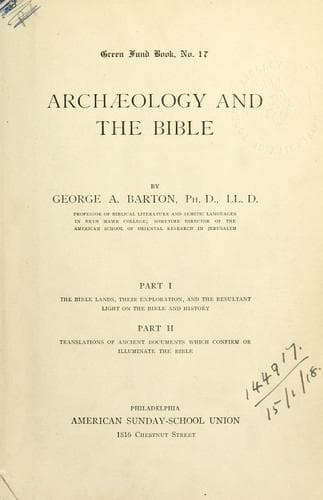
Archæology and the BibleBarton, George A. (George Aaron)
Religion
Archæology and the Bible
Barton, George A. (George Aaron)
Bible -- Antiquities; Egypt -- Antiquities; Middle East -- Antiquities
§ 8. If a man has stolen ox, or sheep, or ass, or pig, or a boat,
either from a god (temple) or a palace, he shall pay thirtyfold. If he
is a poor man, he shall restore tenfold. If the thief has nothing to
pay, he shall be put to death.
§ 9. If a man, who has lost anything, finds that which was lost in a
man’s hand, (and) the man in whose hand the lost thing was found says:
“A seller sold it; I bought it before witnesses”; and the owner of the
lost thing says: “I will bring witnesses who know that the lost thing
is mine”; if the purchaser brings the seller who sold it to him and
the witnesses in whose presence it was bought, and the owner of the
lost thing brings the witnesses who know that the lost thing is his,
the judges shall examine their testimony. The witnesses before whom
the purchaser purchased it, and the witnesses who know the lost thing,
shall give their testimony in the presence of a god. The seller is a
thief; he shall be put to death. The owner of the lost thing shall
take that which was lost. The purchaser shall take from the house of
the seller the money which he had paid.
§ 10. If the purchaser does not produce the seller who sold it to him
and the witnesses before whom he bought it, and the owner of the lost
thing produces the witnesses who know that the lost thing is his, the
purchaser is the thief; he shall be put to death. The owner of the
lost thing shall take that which he lost.
§ 11. If the owner of the lost thing does not bring the witnesses who
know that the lost thing is his, he is one who has attempted fraud; he
shall be put to death.
§ 12. If the seller has died, the purchaser shall recover from the
house of the seller the damages of that case fivefold.
§ 13. If that man has not his witnesses near, the judges shall set an
appointed time within six months; and if, within six months, his
witnesses he does not produce, that man is a liar; the penalty of that
case he shall himself bear.
The Hebrew laws comparable to these are found in Exod. 22:1-4, 9, and Lev.
6:3-5. Exodus directs (v. 1) that, if a man steals an ox or a sheep and
kills it or sells it, he shall restore live oxen for an ox and four sheep
for a sheep. In case it is not sold he shall restore double (v. 9). No
highly organized courts appear in the Biblical codes. The thief was
brought before God and his guilt determined by some religious test. The
law of Leviticus required a man guilty of theft to restore the lost
property, adding to it a fifth more, and to offer a ram in sacrifice. (See
Exod. 18:13-26. Cf. 2 Chron. 19:5-7 with 1 Chron. 23:4 and Deut.
16:18-20.)
The Babylonian laws presuppose a much more highly organized social
community than the Hebrew.
Against Stealing Children and Slaves
§ 14. If a man steals the son of a man who is a minor, he shall be put
to death.
Public-domain text, read in full here on John Shaqi.
Reviews
Reviews
No reviews yet
Be the first to share your thoughts on this work.
Elsewhere in the archive
Join the Discussion
Join the discussion
Sign in to leave a comment or review.
Sign InorCreate an account