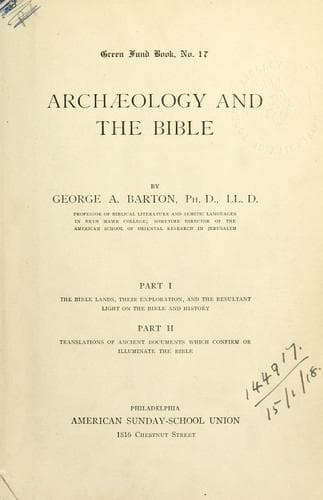
Archæology and the BibleBarton, George A. (George Aaron)
Religion
Archæology and the Bible
Barton, George A. (George Aaron)
Bible -- Antiquities; Egypt -- Antiquities; Middle East -- Antiquities
§ 27. If a soldier or a constable is detained in a royal fortress and
after him they give his field or garden to another and he takes it
and carries it on, if the first one returns and reaches his city, they
shall restore to him his field and garden, and he shall take it and
carry it on.
§ 28. If a soldier or a constable who is detained in a royal fortress
has a son who is able to carry on his business, they shall give to him
his field and garden and he shall carry on the business of his father.
§ 29. If his son is small and not able to carry on the business of his
father, they shall give one-third of his field and garden to his
mother and she shall rear him.
§ 30. If a soldier or a constable from the beginning of his
appointment neglects his field, garden, and house and leaves them
uncared for, another after him shall take his field, garden, and
house, and carry on his business for three years. If he returns and
desires his field, garden, and house, they shall not give them to him.
He who has taken them and carried on the business shall carry it on.
§ 31. If he leaves it uncared for but one year and returns, they shall
give him his field, garden, and house, and he shall carry on his own
business.
§ 32. If a merchant ransoms a soldier (?) or a constable who, on a
journey of the king, was detained, and brings him back, to his city,
if in his house there is sufficient ransom, he shall ransom himself.
If in his house there is not sufficient to ransom him, by the temple
of his city he shall be ransomed. If in the temple of his city there
is not a sufficient ransom, he shall be ransomed by the palace. His
field, garden, and house shall not be given for ransom.
§ 33. If a governor or a magistrate harbors a deserting soldier or
accepts and sends a hired substitute on an errand of the king, that
governor or magistrate shall be put to death.
§ 34. If a governor or a magistrate takes the property of a soldier,
plunders a soldier, or hires out a soldier, has defrauded a soldier in
a suit before a sheik, or takes the present which the king has given
to a soldier, that governor or magistrate shall be put to death.
§ 35. If a man buys the cattle or sheep which the king has given to a
soldier, he shall forfeit his money.
§ 36. One shall not sell the field, garden, or house of a soldier,
constable, or tax-collector.
§ 37. If a man has bought the field, garden, or house of a soldier,
constable, or tax-collector, his tablet shall be broken, he shall
forfeit his money; the field, house, or garden shall return to its
owner.
§ 38. A soldier, constable, or tax-collector shall not deed to his
wife or daughter the field, house, or garden, which is his perquisite,
nor shall he assign them for debt.
Public-domain text, read in full here on John Shaqi.
Reviews
Reviews
No reviews yet
Be the first to share your thoughts on this work.
Elsewhere in the archive
Join the Discussion
Join the discussion
Sign in to leave a comment or review.
Sign InorCreate an account