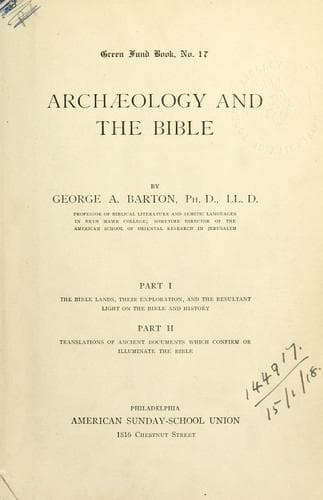
Archæology and the BibleBarton, George A. (George Aaron)
Religion
Archæology and the Bible
Barton, George A. (George Aaron)
Bible -- Antiquities; Egypt -- Antiquities; Middle East -- Antiquities
§ 39. A field, garden, or house which he has purchased and possesses
he may deed to his wife or daughter, or may assign for debt.
§ 40. A priestess, merchant, or other creditor may purchase his field,
garden, or house. The purchaser shall conduct the business of the
field, garden, or house which he has purchased.
§ 41. If a man has bargained for the field, garden, or house of a
soldier, constable, or tax-collector and has given sureties, the
soldier, constable, or tax-collector shall return to the field, house,
or garden, and the sureties which were given him he shall keep.
No such officers as these are mentioned in the laws of the Old Testament,
though some of them appear in earlier times in the records of Babylonia.
The tax-collectors mentioned here remind us of Solomon’s tax-collectors
mentioned in 1 Kings 4:7, ff.
Laws of Agriculture
§ 42. If a man rents a field for cultivation and produces no grain in
that field, they shall call him to account for doing no work in that
field, and he shall give to the owner of the field grain similar to
that of adjacent fields.
§ 43. If he does not cultivate that field and neglects it, he shall
give the owner of the field grain similar to that of adjacent fields,
and the field which he neglected he shall break up with mattocks, he
shall harrow, and return it to the owner of the field.
§ 44. If a man rents an uncultivated field for three years for
improvement and neglects its surface and does not develop the field,
in the fourth year he shall break up the field with mattocks, he shall
hoe and harrow it, and return it unto the owner of the field, and for
every _Gan_ of land he shall measure out 10 _Gur_ of grain.
§ 45. If a man lets his field for pay on shares to a farmer and
receives his rent, and afterward the storm-god inundates the field and
carries off the produce, the loss is the farmer’s.
§ 46. If the rent of his field he has not received, and he has let the
field for one-half or one-third (of the crop), the farmer and the
owner of the field shall divide the grain which is in the field
according to agreement.
§ 47. If the farmer, because he has not in a former year received a
maintenance, entrusts the field to another farmer, the owner of the
field shall not interfere. He would cultivate it, and his field has
been cultivated. At the time of harvest he shall take grain according
to his contracts.
§ 48. If a man has a debt against him and the storm-god inundates his
field and carries away the produce, or if through lack of water grain
has not grown in the field, in that year he shall not make a return of
grain to his creditor; his contract he shall change, and the interest
of that year he shall not pay.
Public-domain text, read in full here on John Shaqi.
Reviews
Reviews
No reviews yet
Be the first to share your thoughts on this work.
Elsewhere in the archive
Join the Discussion
Join the discussion
Sign in to leave a comment or review.
Sign InorCreate an account