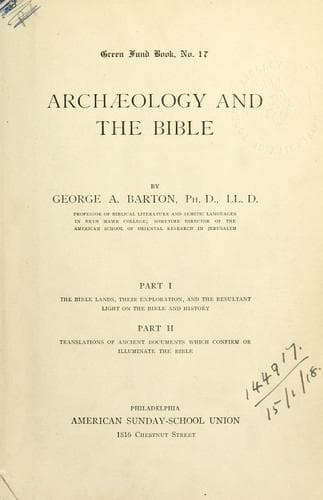
Archæology and the BibleBarton, George A. (George Aaron)
Religion
Archæology and the Bible
Barton, George A. (George Aaron)
Bible -- Antiquities; Egypt -- Antiquities; Middle East -- Antiquities
The Hebrew land laws are found in Exod. 22:5, 6; 23:10, 11; Lev. 19:9, and
Deut. 24:19-22; 23:24, 25. An examination of these passages reveals a wide
difference between Babylonia and Israel. In Babylonia it seems to have
often been the rule that a landlord let out the fields to tenants to work;
among the Hebrews the law presupposes that each man shall work his own
land. Many of the Babylonian laws are designed to secure the respective
rights of landlord and tenant. Naturally, there is nothing in the Old
Testament to correspond to these. Hebrew law (Exod. 22:5), like the
Babylonian, provides that one who causes a neighbor’s crop to be eaten
shall make restitution, but the regulations are of the most general
character. In Babylonia a larger social experience had made much more
specific regulations necessary.
The characters of the respective countries are reflected in the dangers
from which crops might be threatened. In waterless Palestine a fire
started by a careless man might burn his neighbor’s crop (Exod. 22:6); in
Babylonia, where irrigation from canals was conducted to fields lower than
the surface of the water, one might flood his neighbor’s field and destroy
his crop by carelessly leaving his sluice open.
The Hebrew legislation presupposes a poorer community. It provides that
the land shall lie fallow, and whatever it produces shall belong to the
poor (Exod. 23:10, 11). At harvest-time, too, one must not reap the
corners of his field; that was left to the poor (Lev. 19:9). If one forgot
a sheaf in his field, he must not return to take it; that should be left
to the poor (Deut. 24:19). Rich Babylonia made no such provision for the
poor; it felt no such social sympathy.
Again, even these agricultural laws show that commerce was highly
developed in Babylonia, with its necessary concomitant, the right to
charge interest for money. The uncommercial Hebrews regarded interest as
unlawful (Exod. 22:25), and it was Hillel, the contemporary of Herod the
Great, who invented an interpretation known as the Prosbūl, which
practically did away with this law and permitted Jews to take interest.
Horticultural Laws
§ 59. If a man shall cut down a tree in a man’s orchard without the
consent of the owner, he shall pay ½ mana of silver.
§ 60. If a man gives a field to a gardener to plant as an orchard, the
gardener shall plant the orchard and cultivate it for 4 years. In the
fifth year the owner of the orchard and the gardener shall share it
together. The owner of the orchard shall mark off his share and take
it.
§ 61. If the gardener in planting does not complete it, but leaves a
part of it waste, unto his portion they shall count it.
Public-domain text, read in full here on John Shaqi.
Reviews
Reviews
No reviews yet
Be the first to share your thoughts on this work.
Elsewhere in the archive
Join the Discussion
Join the discussion
Sign in to leave a comment or review.
Sign InorCreate an account