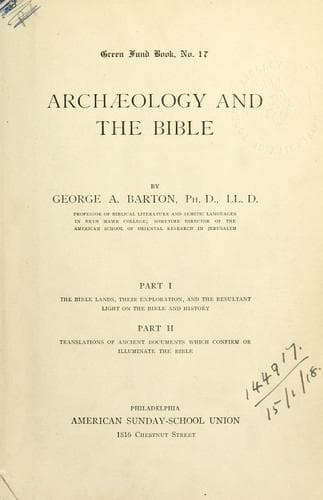
Archæology and the BibleBarton, George A. (George Aaron)
Religion
Archæology and the Bible
Barton, George A. (George Aaron)
Bible -- Antiquities; Egypt -- Antiquities; Middle East -- Antiquities
§ 49. If a man borrows money from a merchant, and has given to the
merchant a field planted with grain or sesame, and says to him:
“Cultivate the field and harvest and take the grain or sesame which it
produces”; if the tenant produces grain or sesame in the field, at the
time of harvest the owner of the field shall take the grain or sesame
which was produced by the field, and shall give to the merchant grain
for the money which he borrowed from the merchant with its interest,
and for the maintenance of the farmer.
§ 50. If the field was already planted [with grain or] sesame, the
owner of the field shall receive the grain or the sesame which is
produced in the field, and the money and its interest he shall return
to the merchant.
§ 51. If there is not money to return, he shall give to the merchant
[the grain or] sesame for the money and its interest which he had
received from the merchant, according to the scale of prices fixed by
the king.
§ 52. If the farmer does not produce grain or sesame in his field, he
shall not alter his contract.
§ 53. If a man the side of his strong dyke has neglected and has not
strengthened it, and in his dyke a break occurs, and the water
destroys the farm-land, the man in whose dyke the break occurred shall
restore the grain which was destroyed.
§ 54. If he is not able to restore the grain, they shall sell him and
his possessions for money, and the owners of the fields whose grain
was destroyed shall share it.
§ 55. If a man has opened his sluice for watering and has left it open
and the water destroys the field of his neighbor, he shall measure out
grain to him on the basis of that produced by neighboring fields.
§ 56. If a man opens the water and the water destroys the work[462] of
a neighboring field, he shall measure out 10 _Gur_ of grain for each
_Bur_ of land.
§ 57. If a shepherd causes his sheep to eat vegetation and has not
made an agreement with the owner of the field, and without the consent
of the owner of the field has pastured his sheep, the owner of the
field shall harvest that field, and the shepherd who without the
consent of the owner of the field caused his sheep to eat the field,
shall pay the owner of the field in addition 20 _Gur_ of grain for
each _Bur_ of land.
§ 58. If, after the sheep have come up out of the fields and are
turned loose on the public common by the city gate, a shepherd turns
his sheep into a field and causes the sheep to eat the field, the
shepherd shall oversee the field which he caused to be eaten, and at
harvest-time he shall measure to the owner of the field 60 _Gur_ of
grain for each _Bur_ of land.
Public-domain text, read in full here on John Shaqi.
Reviews
Reviews
No reviews yet
Be the first to share your thoughts on this work.
Elsewhere in the archive
Join the Discussion
Join the discussion
Sign in to leave a comment or review.
Sign InorCreate an account