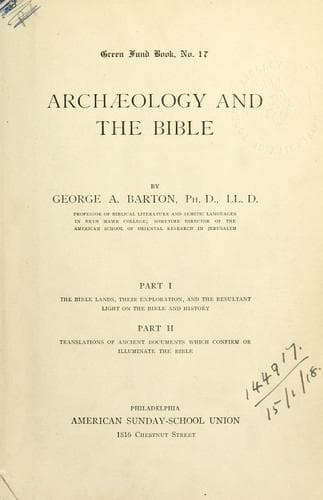
Archæology and the BibleBarton, George A. (George Aaron)
Religion
Archæology and the Bible
Barton, George A. (George Aaron)
Bible -- Antiquities; Egypt -- Antiquities; Middle East -- Antiquities
§ 106. If an agent receives money from a merchant and has a dispute
with his merchant about it, that merchant shall put the agent on trial
on oath before the elders concerning the money he received and the
agent shall pay the merchant three times as much as he received.
§ 107. If a merchant lends to an agent and the agent returns to the
merchant whatever the merchant had given him, if the merchant has a
dispute with him about it, that agent shall put the merchant on trial
on oath in the presence of the elders, and the merchant, because he
had a dispute with his agent, whatever he received he shall give to
the agent six times as much.
The Hebrews of the Old Testament time were not a commercial people and had
no such laws. Men today are inclined to think that the drummer, or
traveling salesman, is a modern invention, but these laws show that he was
an old institution in Babylonia four thousand years ago.
Wine Merchants
§ 108. If a woman who keeps a wine-shop does not receive grain as the
price of drink, but takes money of greater value, or makes the measure
of drink smaller than the measure of grain, that mistress of a
wine-shop they shall put on trial and into the water shall throw her.
§ 109. If the mistress of a wine-shop collects criminals in her house,
and does not seize these criminals and conduct them to the palace,
that mistress of a wine-shop shall be put to death.
§ 110. If the wife of a god (_i. e._, a consecrated temple-woman), who
is not living in the house appointed, opens a wine-shop or enters a
wine-shop for a drink, they shall burn that woman.
§ 111. If the mistress of a wine-shop gives 60 _Qa_ of _sakani_-plant
drink on credit at the time of harvest, she shall receive 50 _Qa_ of
grain.
The Old Testament affords no parallel. There were no wine-shops in Israel
so far as we know, and such consecrated women were prohibited by Deut.
23:17.
Deposits and Distraints
§ 112. If a man continually traveling has given silver, gold, precious
stones, or property to a man and has brought them to him for
transportation, and that man does not deliver that which was for
transportation at the place to which it was to be transported, but has
appropriated it, the owner of the transported goods shall put that man
on trial concerning that which was to be transported and was not
delivered, and that man shall deliver unto the owner of the
transported goods five times as much as was entrusted to him.
§ 113. If a man has grain or money deposited with a man and without
the consent of the owner he takes grain from the heap or the granary,
they shall prosecute that man because he took grain from the heap or
the granary without the consent of the owner, and the grain as much as
he took he shall return, and whatever it was he shall forfeit an equal
amount.
Public-domain text, read in full here on John Shaqi.
Reviews
Reviews
No reviews yet
Be the first to share your thoughts on this work.
Elsewhere in the archive
Join the Discussion
Join the discussion
Sign in to leave a comment or review.
Sign InorCreate an account