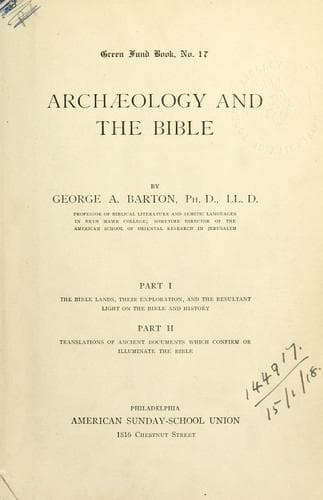
Archæology and the BibleBarton, George A. (George Aaron)
Religion
Archæology and the Bible
Barton, George A. (George Aaron)
Bible -- Antiquities; Egypt -- Antiquities; Middle East -- Antiquities
§ 119. If a man is subjected to an attachment for debt and sells a
maid-servant who has borne him children, the owner of the maid-servant
shall pay and shall release his maid-servant.
These laws are quite similar to Exod. 21:2-11 and Deut. 15:12-18.
The main differences are that the Hebrew law contemplates that a man may
enter slavery himself; the Babylonian only that he shall permit his wife,
son, or daughter to do it. The Hebrews released such slaves at the end of
six years;[467] the Babylonians at the end of three. Hebrew law
recognized, too, that a man might sell his daughter into slavery (Exod.
21:7-11), but it stipulated that her treatment should be different from
that of men. It recognizes that either her master or his son would be
likely to make her a real or a secondary wife. She was not to be released
at the end of seven years, but in case her master did not deal with her in
certain specified ways she regained her freedom regardless of her period
of service.
Storage of Grain
§ 120. If a man has stored his grain in heaps in the building of
another and an accident happens in the granary, or the owner of the
building has disturbed the heap and taken grain, or has disputed the
amount of grain that was stored in his building, the owner of the
grain shall give an account of his grain under oath, the owner of the
building shall double the amount of grain which he took and restore it
to the owner of the grain.
§ 121. If a man stores grain in a man’s building, he shall pay each
year 5 _Qa_ of grain for each _Gur_ of grain.
These laws have no Biblical parallel.
Deposits and Losses
§ 122. If a man gives to another on deposit silver or gold or anything
whatever, anything as much as he deposits he shall recount to
witnesses and shall institute contracts and make the deposit.
§ 123. If without witnesses and contracts he has placed anything on
deposit and at the place of deposit they dispute it, that case has no
penalty.
§ 124. If a man gives to another on deposit silver or gold or anything
whatever in the presence of witnesses and he disputes it, he shall
prosecute that man and he shall double whatever he disputed and shall
repay it.
§ 125. If a man places anything on deposit and at the place of deposit
either through burglary or pillage anything of his is lost, together
with anything belonging to the owner of the building, the owner of the
building who was negligent and lost what was given him on deposit
shall make it good and restore it to the owner of the goods. The owner
of the house shall institute a search for whatever was lost and take
it from the thief.
§ 126. If a man has not lost anything, but says he has lost something,
or files a claim as though he had lost something, he shall give
account of his claim on oath, and whatever he brought suit for he
shall double and shall give for his claim.
Public-domain text, read in full here on John Shaqi.
Reviews
Reviews
No reviews yet
Be the first to share your thoughts on this work.
Elsewhere in the archive
Join the Discussion
Join the discussion
Sign in to leave a comment or review.
Sign InorCreate an account