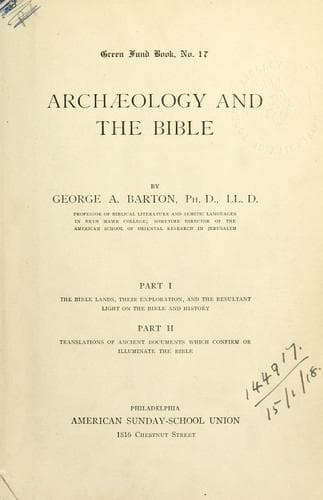
Archæology and the BibleBarton, George A. (George Aaron)
Religion
Archæology and the Bible
Barton, George A. (George Aaron)
Bible -- Antiquities; Egypt -- Antiquities; Middle East -- Antiquities
§ 146. If a man takes a priestess and she gives to her husband a
maid-servant and she bears children, and afterward that maid-servant
would take rank with her mistress; because she has borne children her
mistress may not sell her for money, but she may reduce her to bondage
and count her among the female slaves.
§ 147. If she has not borne children, her mistress may sell her for
money.
§ 148. If a man takes a wife and she is attacked by disease, and he
sets his face to take another, he may do it. His wife who was attacked
by disease he may not divorce. She shall live in the house he has
built and he shall support her as long as she lives.
§ 149. If that woman does not choose to live in the house of her
husband, he shall make good to her the dowry which she brought from
her father’s house and she may go away.
§ 150. If a man presents his wife with field, garden, house, or goods,
and gives to her sealed deeds, after her husband’s death her children
shall not press a claim against her. The mother after her death may
leave it to her child whom she loves, but to a brother she may not
leave it.
§ 151. If a wife who is living in the house of a husband has persuaded
her husband and he has bound himself that she shall not be taken by a
creditor of her husband; if that man had a debt against him before he
took that woman, the creditor may not hold that woman, and if that
woman had a debt against her before she entered the house of her
husband, her creditor may not hold her husband.
§ 152. If they become indebted after the woman enters the man’s house,
both of them are liable to the merchant.
§ 153. If a woman causes the death of her husband on account of
another man, that woman they shall impale.
§ 154. If a man has known his daughter, the city shall drive out that
man.
§ 155. If a man has betrothed a bride to his son and his son has known
her and he afterward lies in her loins and they catch him, they shall
bind that man and throw him into the water.
§ 156. If a man has betrothed a bride to his son and his son has not
known her and he lies in her loins, he shall pay her half a mana of
silver and restore to her whatever she brought from the house of her
father, and the man of her choice may marry her.
§ 157. If a man after his father’s death lies in the loins of his
mother, they shall burn both of them.
§ 158. If a man after his father’s death is admitted to the loins of
his chief wife who has borne children, that man shall be expelled from
the house of his father.
§ 159. If a man who has brought a present unto the house of his
father-in-law and has given a bride-price looks with longing upon
another woman, and says to his father-in-law: “Thy daughter I will not
take,” the father of the daughter shall keep whatever was brought to
him.
Public-domain text, read in full here on John Shaqi.
Reviews
Reviews
No reviews yet
Be the first to share your thoughts on this work.
Elsewhere in the archive
Join the Discussion
Join the discussion
Sign in to leave a comment or review.
Sign InorCreate an account