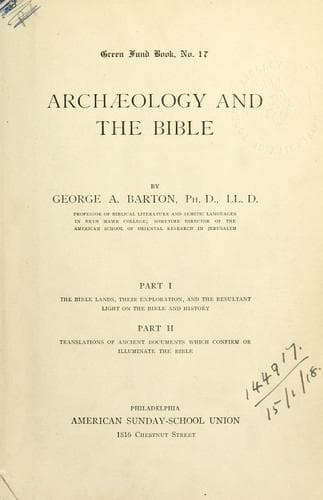
Archæology and the BibleBarton, George A. (George Aaron)
Religion
Archæology and the Bible
Barton, George A. (George Aaron)
Bible -- Antiquities; Egypt -- Antiquities; Middle East -- Antiquities
§ 160. If a man brings a present to the house of a father-in-law and
gives a bride-price, and the father of the daughter says: “I will not
give thee my daughter,” whatever was brought him he shall double and
restore it.
§ 161. If a man brings a present to the house of his father-in-law and
gives a bride-price, and his neighbor slanders him, and the father
says to the groom: “Thou shalt not take my daughter,” whatever was
brought he shall double and restore to him.
These Babylonian laws present numerous points of contact and of
divergence, when compared with the Biblical laws on the same subject.
There is no Biblical parallel to § 128. The law (§ 129) which imposes the
death penalty upon a man who commits adultery with another man’s wife and
upon the woman, finds an exact parallel in Lev. 20:10 and Deut. 22:22,
though the Biblical law, unlike the Babylonian, provides no way in which
clemency could be extended to the offenders.
The laws in §§ 130, 156, concerning the violation of betrothed virgins,
are in a general way paralleled by Lev. 19:20-22 and Deut. 22:23-26,
though there are such differences that, while the underlying principles
are the same, it is clear that there was entire independence of
development. A religious element enters into Leviticus that is entirely
absent from the Babylonian code. The Bible contains two laws on this
subject that are without parallel in the Babylonian code. These are found
in Exod. 22:16, 17 and Deut. 22:28, 29, and impose penalties for the
violation of virgins who were not betrothed. In both codes the principle
is manifest that the loss of a girl’s honor was to be compensated by
money, though Deut. 22:28, 29 recognizes that it has a value that money
cannot buy.
The laws relating to a wife whose fidelity is suspected (§§ 131, 132) find
a general parallel in Num. 5:11-28. The provision at the end of § 132 that
the wife should plunge into the sacred river is in the nature of trial by
ordeal. The law in Numbers imposes on such a woman trial by ordeal, though
it is of a different sort. She must drink water in which dust from the
floor of the sanctuary is mingled--dust surcharged with divine
potency--and if she does not swell up and die, she is counted innocent.
The laws which provide that a wife may present her husband with a
slave-girl as a concubine (§§ 137, 144-147) are without parallel in the
Biblical codes, but are strikingly illustrated by the patriarchal
narratives. Sarah gave Hagar to Abraham (Gen. 16); Rachel and Leah gave
Bilhah and Zilpah to Jacob (Gen. 30:1-13). The law (§ 146) which deals
with such a slave-girl who would rank with her mistress is closely
parallel to the story of the treatment of Hagar in Gen. 16:5-7 and 21:9,
10.
Public-domain text, read in full here on John Shaqi.
Reviews
Reviews
No reviews yet
Be the first to share your thoughts on this work.
Elsewhere in the archive
Join the Discussion
Join the discussion
Sign in to leave a comment or review.
Sign InorCreate an account