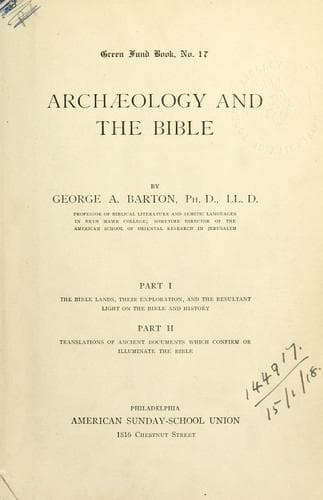
Archæology and the BibleBarton, George A. (George Aaron)
Religion
Archæology and the Bible
Barton, George A. (George Aaron)
Bible -- Antiquities; Egypt -- Antiquities; Middle East -- Antiquities
§ 179. If there is a wife of a god, priestess, or sacred harlot, whose
father has given her a dowry and written a record of gift; and in the
record of gift he has written, “after her she may give it to
whomsoever she pleases,” and has granted her full discretion; after
her father dies she may give it after her to whomsoever she pleases.
Her brothers have no claim upon her.
§ 180. If a father does not give a dowry to his daughter, a priestess
living in the appointed house, or a sacred harlot, after the father
dies she shall receive from the goods of her father’s house the same
share as one son, and as long as she lives she shall enjoy it. After
her it belongs to her brothers.
§ 181. If the father of a priestess, sacred harlot, or temple maiden
gives her to a god and does not give her a dowry, after the father
dies she shall receive from the goods of her father’s house a third of
the portion of a son and shall enjoy it as long as she lives. After
her it belongs to her brothers.
§ 182. If a father does not give a dowry to his daughter, a priestess
of Marduk of Babylon, and does not write a record of gift for her;
after her father dies she shall receive from the goods of her father’s
house one-third of the portion of a son, and shall pay no tax. A
priestess of Marduk after her death may leave it to whomsoever she
pleases.
§ 183. If a father presents a dowry to his daughter who is a
concubine, and gives her to a husband and writes a record of gift;
after the father dies she shall not share in the goods of her father’s
house.
§ 184. If a father does not present a dowry to his daughter who is a
concubine and does not give her to a husband; after her father’s death
her brothers shall give her a dowry according to the value of the
father’s estate and shall give her to a husband.
In comparison with these Babylonian laws of inheritance those in the Old
Testament are comparatively simple. We learn from Deut. 21:15-17, that a
man’s firstborn son received a “double portion” of his father’s estate,
_i. e._, twice as much as any other son. The inference is that the other
sons shared equally. This law also provides that, when a man has two
wives, the sons of the favorite wife shall have no advantage as to
inheritance over the sons of the less loved wife. In Num. 27:8-11 it is
provided that if a man has no son, his estate (_i. e._, real estate) may
go to his daughter; if he has no daughter, it may go to his brothers; if
no brothers, it goes to his father’s brothers. If his father has no
brothers, the estate is to go to the next of kin. In Num. 36:2-12 the law
that a daughter may inherit her father’s estate is supplemented by the
provision that such a daughter must marry within the tribe, so that the
landed property may not in the next generation pass out of the tribe.
Public-domain text, read in full here on John Shaqi.
Reviews
Reviews
No reviews yet
Be the first to share your thoughts on this work.
Elsewhere in the archive
Join the Discussion
Join the discussion
Sign in to leave a comment or review.
Sign InorCreate an account