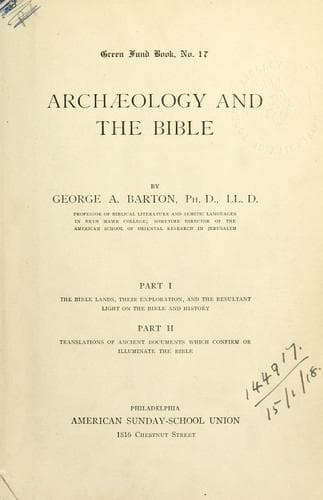
Archæology and the BibleBarton, George A. (George Aaron)
Religion
Archæology and the Bible
Barton, George A. (George Aaron)
Bible -- Antiquities; Egypt -- Antiquities; Middle East -- Antiquities
§ 175. If a slave of the palace or the slave of a workingman takes the
daughter of a patrician and she bears children, the owner of the slave
shall have no claim for service on the children of the daughter of a
patrician.
§ 176. But if a slave of the palace or the slave of a workingman takes
the daughter of a patrician, and when he takes her she enters together
with the dowry from her father’s house into the house of the slave of
the palace or the slave of the workingman; if after they are united
they build a house and acquire property and afterward the slave of the
palace or the slave of the workingman dies, the daughter of the
patrician shall receive her dowry and they shall divide into two parts
whatever her husband and herself had acquired after their union. Half
the owner of the slave shall take, and the daughter of the patrician
shall receive half for her children. If the daughter of the patrician
had no dowry, whatever her husband and herself had acquired after
their union they shall divide into two parts. The owner of the slave
shall take half and the daughter of the patrician shall receive half
for her children.
§ 177. If a widow whose children are minors sets her face to enter the
house of a second husband, she shall not do it without the consent of
the judges. When she enters the house of a second husband, the judges
shall inquire into the estate of her former husband, and the estate of
the former husband they shall entrust to the second husband and to
that woman, and shall cause them to leave a tablet (receipt). The
estate they shall guard and rear the minors. The household goods they
may not sell. The purchaser of household goods belonging to the
children of a widow shall forfeit his money. The goods shall revert to
their owners.
§ 178. If there is a wife of a god, priestess, or sacred harlot, whose
father has given her a dowry and written her a record of gift, and in
the record of gift he has not written, “after her she may give it to
whomsoever she pleases,” and has not given her full discretion; after
her father dies her brothers shall take her field and garden, and
according to the value of her share they shall give her grain, oil,
and wool, and shall content her heart. If her brothers shall not give
her grain, oil, and wool, according to the value of her share, and
shall not content her heart, she may let her field and garden unto any
tenant she pleases and her tenant shall maintain her. Her field,
garden, or whatever her father gave her she may enjoy as long as she
lives. She may not sell it for money or transfer it to another. Her
heritage belongs to her brothers.
Public-domain text, read in full here on John Shaqi.
Reviews
Reviews
No reviews yet
Be the first to share your thoughts on this work.
Elsewhere in the archive
Join the Discussion
Join the discussion
Sign in to leave a comment or review.
Sign InorCreate an account