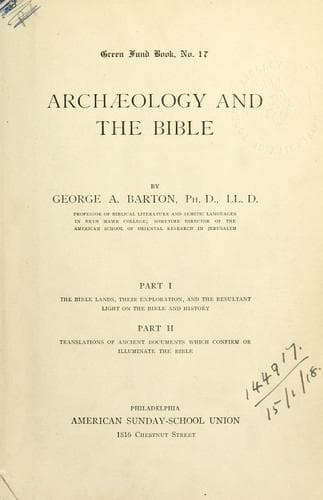
Archæology and the BibleBarton, George A. (George Aaron)
Religion
Archæology and the Bible
Barton, George A. (George Aaron)
Bible -- Antiquities; Egypt -- Antiquities; Middle East -- Antiquities
Nuffar, the ancient Nippur, was one of the oldest centers of Babylonian
civilization, and the work of the Americans there is, for our knowledge of
the history of ancient Babylonia, next in importance to that done by the
French at Telloh. A large number of the tablets discovered at Nippur are
now in the University Museum in Philadelphia. Meantime, the Turkish
government had undertaken on its own account an excavation at Abu Haba,
the site of the ancient Sippar in northern Babylonia. The direction of the
work was committed to the oversight of the French Assyriologist Père
Scheil, and the work was carried on in the early part of the year 1894.
Much interesting material was brought to light.
_By Koldewey._--Also during this decade a new Society, the
_Orient-Gesellschaft_, had been formed in Berlin for the purpose of
excavation. This Society began in 1899 the excavation of the great mound
which covered the ruins of the ancient city of Babylon. The work was
committed to the direction of Dr. Robert Koldewey, who has carried it
steadily forward until the present time. Koldewey has laid bare at Babylon
a number of the great works of King Nebuchadrezzar--the magnificent walls
with which he surrounded Babylon, and the palace and temples with which he
adorned it. As the work at Babylon has progressed, Koldewey has made a
number of minor excavations in smaller mounds of Babylonia. During the
season of 1912-1913 Dr. Julius Jordan undertook, under Dr. Koldewey’s
general direction, an excavation at Warka, the Biblical Erech, where
Loftus had dug sixty years before. A part of the great temple of Ishtar
has been uncovered by Dr. Jordan, together with a portion of the city wall
and many houses. Many tablets have also been found, some of them having
been written as late as the Seleucid and Parthian periods, 312-50 B. C.;
(see Fig. 18).
_By Andrae._--While the excavation at Babylon has been in progress, the
_Orient-Gesellschaft_ has also conducted another at Kalah-Sherghat, on the
Tigris, in ancient Assyria. This is the site of the city of Ashur, from
which the country of Assyria took its name. (Cf. Gen. 10:10, 11.) The work
has been under the direction of Dr. Andrae and has been in progress from
1902 to the present time. Temples and palaces have been uncovered, and
inscriptions from every period of Assyrian history have been found. The
latest reports of the work at Ashur tell of the discovery of objects which
connect the founding of the city with immigrants from Lagash in southern
Babylonia.
Public-domain text, read in full here on John Shaqi.
Reviews
Reviews
No reviews yet
Be the first to share your thoughts on this work.
Join the Discussion
Join the discussion
Sign in to leave a comment or review.
Sign InorCreate an account