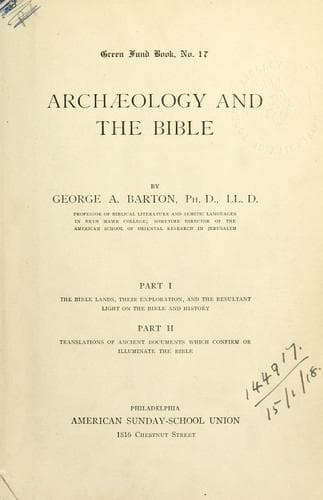
Archæology and the BibleBarton, George A. (George Aaron)
Religion
Archæology and the Bible
Barton, George A. (George Aaron)
Bible -- Antiquities; Egypt -- Antiquities; Middle East -- Antiquities
(2) _Peiser._--In 1892 Dr. Peiser, then of Breslau University, published
his book on the Hittite inscriptions, in which he essayed another method
of decipherment. Layard had found four Hittite seals in the palace of
Sennacherib at Nineveh. Peiser inferred that these must be seals of four
Hittite kings mentioned in the inscriptions of that time, and proceeded to
assign each seal to the name of a known Hittite king, and interpret the
signs on the seal by the name of that king as spelled out in the cuneiform
characters of the Assyrian inscriptions. Having obtained in this way
tentative values for several signs, he proceeded by inference to guess at
other signs, and so tentatively read some inscriptions.
(3) _Jensen._--Prof. Jensen, of Marburg, wrote in that same year an
unfavorable review of Peiser’s work. When reading the proofs of his review
he added a postscript to say that he believed he had himself discovered
the key to Hittite. Two years later, 1894, he published in the Journal of
the German Oriental Society his method of solving the problem. Jensen’s
starting-point was gained from inscriptions from Jerabis, the site of
ancient Carchemish, Hamath, and other places. He inferred that a certain
sign was the determinative for city, and that the names preceding this
sign were names of places. Gaining in this way some values for signs, he
read the names of some kings. He found that these names had nominatives
ending in _s_ and accusative cases ending in _m_; he accordingly leaped to
the conclusion that the Hittite language was a member of the Indo-European
group of languages, as this is the only known group of tongues in which
this phenomenon occurs. This inference later research has in part
confirmed. Jensen, however, went further and endeavored to show that the
Hittites were the ancestors of the Armenians of later time. This theory
led to the publication in 1898 of his book, _Hittiter und Armenier_. Of
the correctness of this view he has not been able to convince other
scholars. By this time Jensen and others had begun to see that the
Mitannians and the Hittites were kindred peoples and worshiped the same
gods. It is now recognized that Jensen correctly ascertained the value of
some signs, though many of his guesses, like those of his predecessors,
have proved incorrect.
Public-domain text, read in full here on John Shaqi.
Reviews
Reviews
No reviews yet
Be the first to share your thoughts on this work.
Elsewhere in the archive
Join the Discussion
Join the discussion
Sign in to leave a comment or review.
Sign InorCreate an account