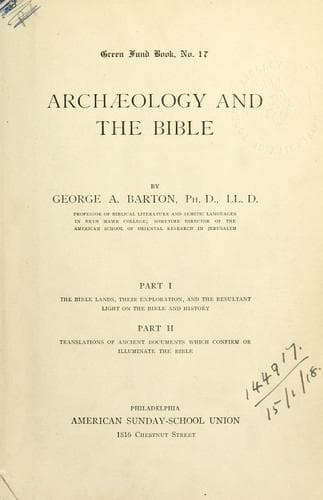
Archæology and the BibleBarton, George A. (George Aaron)
Religion
Archæology and the Bible
Barton, George A. (George Aaron)
Bible -- Antiquities; Egypt -- Antiquities; Middle East -- Antiquities
excavated at Carchemish, in a study of the objects found in tombs at
Carchemish and at other places near by, thinks it possible that the coming
of the Hittites is marked by a transition period in the art--a period the
termination of which he marks by the date of the fall of the first dynasty
of Babylon. It may well be that Indo-Europeans followed by Mongols came
about 2100 or 2000 into this region, or that the Mongols were there
earlier and that the Indo-Europeans then came. In the resultant
civilization it would seem, from the information that we have, that there
was a mingling of the two races; (see Fig. 24).
(2) _Hyksos Possibly Hittites._--Since the Hittites were able to help
overthrow the first dynasty of Babylon, some scholars have recognized the
possibility that those invaders of Egypt who established the dynasties
called Hyksos may have been Hittites, or may have been led by Hittites.
There is much evidence that many Semites entered Egypt at that time, but
as Syria and Palestine were peopled with Semites earlier than this, such
an invasion would naturally have had many Semites among its camp
followers, if not in its armies, even if the leaders were Hittites. At
present, however, this is but a possibility. Some slight evidence in favor
of the possibility may be found in the name of the king of Jerusalem who
was a vassal of Amenophis IV, and who wrote the letters from Jerusalem
which are in the El-Amarna collection. (See Part II, p. 345, ff.) His name
was Abdi-Hepa, and Hepa was a Hittite and Mitannian deity. Abdi-Hepa had
grown up a trusted subject of the Egyptians. His ancestors must,
therefore, have been in Palestine for some time. A settlement of Hittites
there in the Hyksos days would account for this. The twenty-third chapter
of Genesis represents the city of Hebron as in the possession of the
Hittites when Abraham purchased the cave of Machpelah as a place of burial
for his dead, and, though many scholars regard Genesis 23, which gives
this account, as a late composition, its representation would receive some
confirmation from archæology, if the Hyksos were Hittites.
There is a possibility that the Hittites were in southern Palestine
earlier than this. Brugsch[22] thought that he found in an inscription in
the Louvre, written by an officer of Amenemhet I, King of Egypt, 2000-1970
B. C., a statement that this officer had destroyed the palaces of the
Hittites near the Egyptian frontier of Palestine. This reading is still
defended by Prof. Sayce,[23] though other Egyptologists, such as W. Max
Müller[24] and Breasted,[25] claim that the word that was thought to be
Hittites is not a proper name, but a common noun meaning nomads. The text
of the passage is uncertain, and no important inference can in any case be
made from it.
Public-domain text, read in full here on John Shaqi.
Reviews
Reviews
No reviews yet
Be the first to share your thoughts on this work.
Elsewhere in the archive
Join the Discussion
Join the discussion
Sign in to leave a comment or review.
Sign InorCreate an account