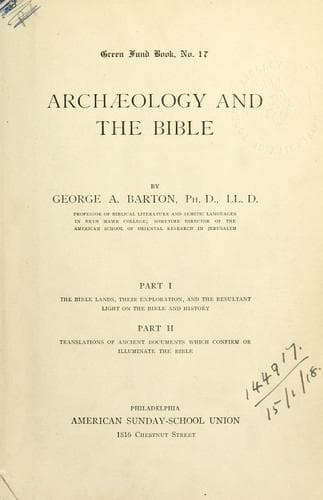
Archæology and the BibleBarton, George A. (George Aaron)
Religion
Archæology and the Bible
Barton, George A. (George Aaron)
Bible -- Antiquities; Egypt -- Antiquities; Middle East -- Antiquities
Assyria had become weak, so that Hattusil was no longer pressed upon his
eastern border. After a little he reduced the Amorites once more to
submission, and compelled them to take back their king, Put-akhi, whom
they had driven out at the time of their rebellion against Mutallu. He
gave Put-akhi a Hittite princess for a wife. Later, about 1271 B. C.,
Hattusil concluded an offensive and defensive alliance with Ramses II of
Egypt. The treaty which guaranteed this alliance has come down to us, and
is the first international treaty the details of which are known to us.
(See Chapter I, p. 30.)
Hattusil II must have enjoyed a long reign, but we do not know the date of
his death. He had two successors, Dudkhalia and Arnuanta, whose reigns are
known to us, and who continued the sway of the dynasty down to about 1200
B. C. They were respectively the son and grandson of Hattusil II. An edict
of Dudkhalia concerning the vassal states has survived, in which the name
of Eni-Teshub, King of Carchemish, appears. Carchemish would seem to have
been the chief of the allied states. Of Arnuanta we have no details,
though two fragments of royal edicts and a seal of his have come down to
us. He was called “the great king, the son of Dudkhalia.” After him our
sources fail, and the story ends in darkness. We know, however, that the
days of the power of this dynasty were over. Egyptian sources tell us that
tribes from western Asia Minor and from beyond the sea swept over Cilicia
and northern Syria soon after the year 1200 B. C., and there was then no
Hittite power there to restrain them.
(5) _Carchemish._--Of the other Hittite kingdoms far less is known.
Carchemish, which, as we have just seen, played an important part in the
federation of the great Hittite power, continued its existence for several
centuries. In the time of Ashurnasirpal II and Shalmeneser III the kingdom
of Carchemish entered into alliance with these kings and preserved its
existence by becoming their vassal. Judging from the meager reports
hitherto published of the British excavation at Carchemish, this was a
flourishing period in the history of the city. A hundred years later, in
the reign of Sargon, Pisiris, who was then king of Carchemish, defied the
Assyrian, who brought the kingdom to an end in 717 B. C. (Cf. Isa. 10:9.)
(6) _Samal and Yadi._--When the Aramæans swept westward about 1300 B. C.
they apparently dislodged the Hittites from a number of their sites and
occupied their country. Among the places so occupied was the site of
Sendjirli mentioned above. All the carvings found among its architectural
remains reveal the influence of Hittite art, but the inscriptions found
there are in Aramaic. These inscriptions show that there were in that
region two petty kingdoms named, respectively, Samal and Yadi. The names
of several kings of these monarchies who ruled between 850 and 730 B. C.
have been recovered. They are all Aramæan.
Public-domain text, read in full here on John Shaqi.
Reviews
Reviews
No reviews yet
Be the first to share your thoughts on this work.
Elsewhere in the archive
Join the Discussion
Join the discussion
Sign in to leave a comment or review.
Sign InorCreate an account