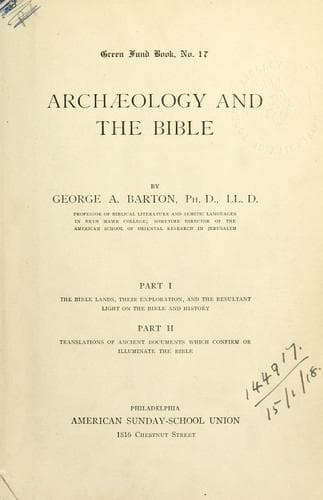
Archæology and the BibleBarton, George A. (George Aaron)
Religion
Archæology and the Bible
Barton, George A. (George Aaron)
Bible -- Antiquities; Egypt -- Antiquities; Middle East -- Antiquities
(7) _Hamath._--Farther to the south, at Hamath on the Orontes, a Hittite
kingdom existed in the time of David. Its king was then called Toi or Tou,
who made an alliance with David (2 Sam. 8:9, f; 1 Chron. 18:9, f.). This
kingdom was probably the outgrowth of the earlier occupation of the
Orontes valley, three hundred years before, by the Hittites of the great
empire. It continued until the time of Ahab. Its king was then Irhulina,
who along with Ahab, Ben-Hadad of Damascus, and several other kings made
an alliance to resist the encroachments of Shalmaneser III of Assyria in
854 B. C. (See Part II, p. 360, ff.) Irhulina caused several inscriptions
to be made on stone, which survived at Hamath until our time. According to
Mr. Thompson’s interpretation of them they are all records of his various
alliances. By the next century, however, the Aramæans had captured Hamath,
for in the reigns of Tiglath-pileser IV (745-727) and of Sargon (722-705
B. C.) the names of its kings were Semitic. These names were,
respectively, Enu-ilu and Yau-bidi, or Ilu-bidi.
We gain glimpses also of a number of other Hittite states. There was, for
example, the state of Kummukh, which lay to the west of the Euphrates, and
another in western Cilicia, that had its center at Tyana, the modern Bor.
These states appear to have reached their zenith after the fall of the
great Hittite dynasty which had its capital at Boghaz Koi. Doubtless as
time goes on we shall learn of the existence of many other small Hittite
kingdoms which flourished at one time or another. At some time, either
when the Hyksos were making their way into Egypt or when Subbiluliuma was
pushing southward into Syria, the Hittites mentioned in the Old Testament
must have made some small settlements in Palestine. Here the Hebrews came
into contact with them. They were really an unimportant outlying fringe of
the great Hittite people, but they had the good fortune to have their
names preserved in the most immortal literature in the world, the Bible,
and so their memory was ever kept alive, while that of their more
illustrious kinsmen was utterly forgotten. It is only archæological
research that has restored something of the original perspective.
CHAPTER IV
PALESTINE AND ITS EXPLORATION
THE LAND: Rainfall. EARLY EXPLORATION: Place names. EARLY AMERICAN
EXPLORATIONS: Robinson and Smith. Lynch. American exploration
societies. PALESTINE EXPLORATION FUND: Warren’s excavations at
Jerusalem. The survey of Palestine. Exploration of Lachish. Bliss’s
excavation at Jerusalem. Excavation at Azekah. At Tell es-Safi
(Gath?). Tell el-Judeideh. At Marash (Moresheth-Gath). Gezer.
Beth-shemesh. Exploring the Wilderness of Zin. THE GERMAN PALESTINE
SOCIETY: Guthe’s excavation at Jerusalem. Megiddo. Taanach. Capernaum.
Jericho. THE AMERICAN SCHOOL AT JERUSALEM. SAMARIA. PARKER’S
EXCAVATIONS AT JERUSALEM. LATEST EXCAVATIONS.
Public-domain text, read in full here on John Shaqi.
Reviews
Reviews
No reviews yet
Be the first to share your thoughts on this work.
Elsewhere in the archive
Join the Discussion
Join the discussion
Sign in to leave a comment or review.
Sign InorCreate an account