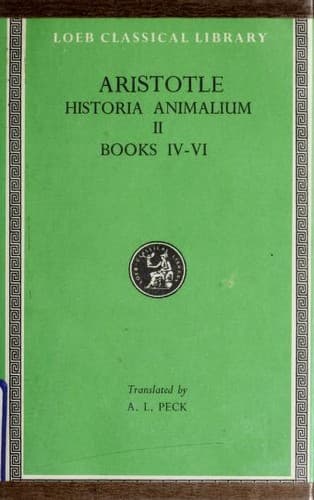
Aristotle's History of Animals: In Ten BooksAristotle
PhilosophyPhilosophy
Aristotle's History of Animals: In Ten Books
Aristotle
Zoology -- Pre-Linnaean works
4. And when the appearances cease to take place directly, the uterus
shows that, if there is any difficulty, it will become empty and dry,
and wanting in moisture, and there will be no remains in the passage.
When the uterus, therefore, is capable of contraction, it shows that it
is in a proper state for receiving whatever is brought to it, when it
is in this state without pain, and indeed is insensate; and it is good
that the os uteri should not be in any other condition. This shows that
there is no reason why it should not close at the proper time. This
is the manner of considering the os uteri, whether it is in a healthy
condition or not.
CHAPTER III.
These ought to be the symptoms of the uterus itself after purification.
First of all, that the woman should dream of sexual intercourse, and
project her seminal fluid readily, as if a man were lying with her;
and if this symptom occur frequently, it is better. And when she has
arisen, sometimes she should require the same treatment as if she had
been with a man, sometimes she should be dry; but this dryness should
not be immediate; but after awaking she should be fluid, sooner or
later, about as much as half a short day. The humidity should be of
the same kind as if she had been with a man. For all this shows that
the uterus is in a fit state to receive what is given it, and that the
cotyledons are drawn up and will retain what they have received, and be
unwilling to part with it.
2. A flatulent state of the uterus is also a good sign, when it
enlarges and discharges the wind as the bowels do without pain, and
when it becomes larger and smaller without any symptom of disease; for
these symptoms show that the uterus is not in want of what is necessary
nor sluggish, either naturally or from disease, but that it will be
able to find room by growth for anything that it may receive, for it
has the power of dilation. When this is not the case, the uterus is too
thick, or some natural defect or disease has rendered it insensible.
For this cause it cannot nourish, but it will destroy the embryo,
if the symptoms are violent, while the embryo is small; if they are
less so, when it is larger; if the uterus is slightly affected, the
offspring will be inferior, as if it had been fed in an inferior vessel.
Public-domain text, read in full here on John Shaqi.
Reviews
Reviews
No reviews yet
Be the first to share your thoughts on this work.
Elsewhere in the archive
Join the Discussion
Join the discussion
Sign in to leave a comment or review.
Sign InorCreate an account